Showing posts with label Oban. Show all posts

Saturday, 5 December 2015

A Spiritual Revelation: Single Malt Whisky

Comedian Rich Hall
I once saw the comedian Rich Hall addressing an audience. He asked if there were any Scottish people in. Answering roars told him that some people came from Edinburgh
          "Ah, Edinburgh," he said. "I once had a spiritual revelation in Edinburgh. It was called, 'Single Malt Whisky.'"
          I feel much the same, though my spirituous revelation didn't happen anywhere in Scotland - and it happened well before I met my Scottish partner. I was already a faithful drinker of single malts by the time I met the Scot.
          It was another man who, one evening, asked me what I was drinking. "Whisky." I said, and his interest was piqued. Which whisky did I favour? - and he reeled off a few of the single malts.
          "Oh, just get me a whisky," I said, in my ignorance. "Doesn't matter which one - I don't believe in all that marketing hype about single malts."
          He was offended. It was not mere marketing hype, he said. A single malt was vastly superior to the cheap, blended stuff. It was made in the place it was named after, from local water and grain. It was lovingly aged - and ya-da-yah, as I thought then, he spouted all the marketing rubbish about sherry and oak casks.
          "It's just branding," I said. "It's just an excuse to charge more."
          Allow him, he said, to do me a kindness and prove me wrong. Allow him, if I would, to buy me a couple of different single malts. Taste them, and then tell him that there was no difference between them and the likes of Jack Daniels, Bell and Johnnie Walker.
          Well, okay, I said, if you're paying.

          I always liked whisky best, of all spirits, ever since I used to sip from older relatives' glasses as a child. But whenever I drank it, the harshness of the alcohol made me shudder to my toes. That was the price, I thought, of liking whisky. You had to put up with the shudder.
  
        I can't remember which whiskys the gentleman bought me. Since he knew he was dealing with a beginner, it was probably a couple of the softer ones. Maybe a Glenfiddich or a Glenlivit for one - they are light, pale yellow and have a lemony, citrusy taste. And perhaps a richer, fruit-cakey one, aged in sherry-casks, such as an Aberlour.
          And it was a spiritual revelation. I drank and I didn't shudder. I realised what 'smooth' means, when applied to spirit. The single malts were so well made and aged that they slipped down with nothing more than a warm glow - and a wealth of flavours.

          Once you're converted, there are so many to try! Jura, Auchentosh, Glenmorangie, Talisker, Dalwhinnie, Craganmore...
All of them a little different. When I did meet the Scot, he told me that his father had been a whisky cooper, and in the course of cooping barrels for many different distilleries, had sampled many, many different whiskys. It was his experienced and considered opinion that the best of them all was a 10-year old Macallan. It didn't, to his taste, improve for being 12, 15 or 30 years old. The ten year old Mac: that was the one.
          And it is excellent - as is Bushmills Irish single malt, though the Scots of my acquaintance frown on Irish whiskys (and, for that matter, American and Japanese 'whiskys.' If it's not from Scotland, it's not whisky, is their thinking.)
          Personally, though, after years of trying different single malts, I'm coming to the conclusion that the best of the lot is, as many agree, Islay's Laphroig. (It's pronounced 'La-FROYg.)

          Scots friends have put forward Lagvulan as their favourite. It's very good - I've yet to meet a single malt I didn't like - but good as it is, it's not Laphroig. 

          I didn't think so when I first tasted Laphroig, years ago. I thought it smelled and tasted like burning rubber or kippers. I much preferred the lighter malts, like Glenfiddich or Oban. Or Highland Park from the Orkneys.
          But, gradually, I learned to like it. Peat smoke and honey is one of those poetic tasting descriptions for Laphroig, and the last time I drank some, I could appreciate what that meant. I could taste the sweeter honey notes coming through the harshness of smoke and iodine. I had another spiritual revelation: I realised I loved Laphroig.

          Still, it doesn't matter: mild Glenfiddich or smoky Laphroig, or spicy Aberlour, or any of the others, there is no spirit that has so much warmth and so many layers and variations in flavour as single malt whisky. I love the stuff.
          I tried to repay the gent who convinced me of the worth of single malt a few months ago. I was passing the shelf of whisky in a well known supermarket, and saw a lady looking confused in front of them. So I went over to check out my next purchase (single malts are my only extravagance) and asked her which one she fancied herself.
          She told me she knew nothing about whisky, but had been charged by her friends with the task of buying a bottle for their retiring manager - who it seemed they all liked. He was a whisky drinker, she said, so they thought a bottle of - and she waved vaguely towards the blends. But now she was here, there were so many different kinds and she was confused.
          Buy him a single malt, I said. If he's a whisky drinker, he'll be grateful. I think I steered her to an Oban in the end - a little bit smoky, but with a spicy, citrus sweetness too.

          This blog comes to you with the faint, but very real hope, that a whisky distillery will be overcome with Christmas good cheer and grant me a lifetime's supply of single malt.
          Or even a single bottle. Go on.
          Just one.
          Go on, go on.


Saturday, 19 July 2014

Barra


     It was in May, a Monday afternoon, full of dull work, and an expectation of nothing more for the rest of the week. About 3pm, the phone rang. It was Davy, my partner. He said, 'Have your bag by the door for 6am, we're going to the Outer Hebrides.'
     I was, as old stories used to say, nothing loathe. I started chucking knickers and socks into a bag.
     The phone rang again. 'Bag by the door at 3-30 am.'
      The full story was that Davy's brother was doing supply teaching on the Isle of Barra, in the secondary school where the entire pupil-roll numbered 94. (The entire population is only 1,174.)
     The brother had a little rented cottage, its spare bedroom currently empty, and we were invited - but we had to be quick off the mark because end of term was coming up, and the brother didn't know for sure how much longer he was going to be there.
     The early start was a necessity because of the ferries. We had to catch the 1pm Cally-Mac from Oban, because there wouldn't be
386 miles
another until the evening of the day after.

      So off we went, in the wee small hours. Davy drove for eight hours. We stopped briefly at Carlisle, for petrol - but the cafe where we usually have a drink on the way to Scotland wasn't even open at 6am. We made it to Oban by around 11-30am, and booked ourselves on the ferry.
     I love Oban, with its view out to Kerrara and Mull, and the other Hebrides - but we didn't see much of it apart from the harbour and the ferry complex this time.

Kerrara (in foreground) and Mull, from Oban

     It took seven hours on the ferry to sail from Oban, past the island of Mull, and then to the Outer Hebrides. We were taking a roundabout route - the ferry calls, on Tuesdays, at Lochboisdale in South Uist, before going on to Castlebay on Barra. The more direct route takes only five hours.
Route from Oban to Castlebay, Barra. The island of Barra marked with red spot.


      We got into Castlebay - so called because there's a castle in the bay - at about 8pm, and were met by brother Jim, who led us around the island to the quiet little inlet where his cottage was.

Davy taking photos on Barra. The only other person on this beach was me.

Well, except for this fella, the beach's only other occupant. Had a pebble. Kept bringing it to be thrown.


The sunny day.

    We had a couple of sunny days, and they were glorious, with blue skies, seas of duck-egg blue and turquoise, and white beaches. I've never seen so many primroses, growing along roadside verges and across whole banks - it made me think of Shakespeare's 'primrose-path.' There were also many of the tiniest little dots of lambs I've ever seen, but they bounced and scarpered off into the landscape, with waving tails, before I could get a good photograph.


      The island is Roman Catholic, and tourists are told that it's named after St. Barr - yet there don't seem to be any legends about the Saint, or any explanation of what he was doing there. In fact, the island's name is a mixture of Gaelic and Norse - the Gaelic 'barro' meaning 'hill,' and the Norse 'ey' meaning 'island.' - 'Hilly island' - a fair enough description. [Room, 1988.]

Why the only town is called 'Castlebay.'
  
     The only town on the island is called by the oddly English name of Castlebay, and this is why - Kisimull Castle, out in the middle of the bay. (The name means 'Castle Island.')
     The castle, and the island of Barra, were the stronghold of Clan MacNeil, and donations came in from MacNeils all around the world, to rebuild the castle when it was gutted by fire. The MacNeils suffered terribly in the 19th Century, the age of the Clearances, partly because their Protestant, absentee landlords felt justified in having their bailiffs burn them out of their crofts and leaving them to starve.
          At its southern end, Barra is linked by a causeway to the island of Vatersay, just as beautiful as Barra, but much less hilly. Davy was taking photographs like mad, and has completed two paintings based on them since we came back. I could see him falling in love with the place, so I'm pretty sure we'll be sailing into Castlebay again.

Vatersay

Davy leaving Vatersay beach for a primrose path.


Saturday, 27 July 2013

How The Collie Dogs Rounded Up A Story


'Some years ago the late Miss Stewart Mackenzie of Brahan, Ross-shire, informed a friend that in the course of journeys by coach in the late autumn from Brahan to the South during her childhood about the year 1840 she used frequently to see collie dogs making their way north unaccompanied. On inquiring of her parents why these dogs were alone, [she] was informed that these were dogs belonging to drovers who had taken cattle to England and that when the droving was finished the drovers returned by boat to Scotland. To save the trouble and expense of their transport, the dogs were turned loose to find their own way north. It was explained that the dogs followed the route taken on the southward journey being fed at Inns or farms where the drove had 'stanced' and that in the following year when the drovers were again on the way south, they paid for the food given to the dogs...'
          I've more than once found inspiration in footnotes. The one above is taken from 'The Drove Roads of Scotland; by A. R. B. Haldane. I read it years ago - at least ten years ago. Those dogs were always trotting about at the edges of my mind.
          Then they met up with the workhouse apprentices I'd read about thirty years ago. For centuries the apprentice system had put a boy to work for a craftsman. In return for his free labour, he recieved food, board and clothing, and a training in a trade.
          With the industrial revolution, this system was corrupted to
provide cheap labour for mills and factories. Pauper children were 'apprenticed' to the mills, where they were set to work for long, long hours in return for the cheapest food and clothing. They learned no skills, except the operation of machinery. At night they were locked up. They were, in everything but name, slaves. Their 'apprentice papers' bound them to the mill-owner until they came of age.
          What, I thought, if a child escaped from this slavery and, in running away, met up with a couple of collie dogs returning home to Scotland? The collies round him up, and as they provide protection and companionship, and he has nowhere else to go, he decides to walk with them wherever they take him. The dogs are heading west, to their home-croft on Mull, but the boy doesn't know that.
          I found out my copy of Haldane's Drove Roads and consulted it. The drove route from the Isle of Mull to London was the one that seized my imagination. There were longer roads - cattle were, in historic fact, brought from the Outer Hebrides and driven down to London, but I decided not to tax modern readers' credulity.
          My partner Davy, being a Scot of Highland descent, took a more than usual interest in this plotting. "It's too long," he said. "You've got to get them all that way. Why not keep it simple and have the dogs on their way back from the market at Falkirk?"
          I don't always take his advice - it's his constant complaint - but on this occasion, I listened. 'Keep it simple, stupid,' is a good rule of thumb.
          But if the boy was walking from somewhere near Falkirk to Mull, the dates wouldn't work too well for him being an escapee from factory enslavement.
          When I said this, Davy told me what he knew about Scotland's 'bond-women' who wore an odd 17th century costume, and were 'bonded' to work on farms right into the early 20th century. Sometimes boys were bonded too, and it was a pretty harsh system. Davy told me of a boy he'd read of who'd been over-worked, under-fed, and made to sleep in a damp shed with thistles growing through his pillow. He'd escaped his bond by enlisting in the army when WWI broke out - and while everyone around him thought barracks life was harsh and the rations short, the bond-boy had never known such luxury in his life.
          So there's my boy, walking west with the dogs, following the drove road out of English speaking Lowland Scotland, into Gaelic-speaking Highland Scotland. I don't know a word of Gaelic. I don't know much about Scots history - nor, unfortunately, do I know a man who does. Davy says, 'They don't teach English history in Scots schools, and when they taught Scots history, I wasn't listening.' Why does my imagination never give me anything easy to do?
          But at least, thanks to Haldane, I know the route he and the dogs would have taken - and last week, Davy and I were up in Scotland, checking it out. And getting bitten by midgies (Davy) and by cleggs (me.)
          We went to the old ferry crossing on Loch Awe, where the drovers took their cattle across.
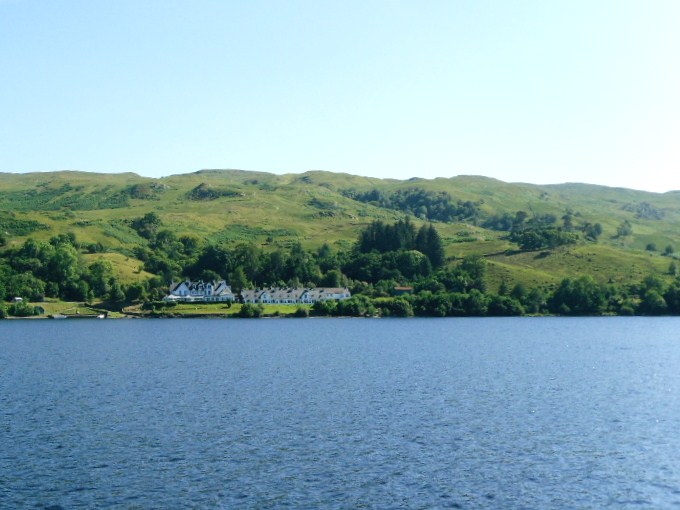
          This is taken from Taychreggan. The building is a modern hotel, but it's situated where the old droving inn stood. The drovers took their cattle across here, and then climbed the hills beyond, heading for Loch Fyne.
          The modern hotels here are pretty swish and exclusive. They take some finding for one thing. It's not casual passing trade they're relying on. The thronged drovers' inns were about as unlike them as it's possible to be. Dr. Johnson gave them terrible reviews on his equivalent of TripAdvisor. They were, according to him, damp, dirty, flea-ridden and with filthy food. But as the drovers lived on oatmeal mixed with water, milk and blood, their taste was robust.
          From Taychreggan, as Davy was feeling strong, we took the road less travelled, via Glen Nant and Glen Lonan, to the town of Oban. So we came in over the hills, as the drovers would have done.
          The journey was beautiful, but only for drivers of strong nerve. The sheep don't help, as they lie in the road, toasting their little trotters on the hot tarmac, and giving not a spit for tourists in cars. The mountains - ('Hills,' Davy says, 'they're hills.') - the mountains rose above us and leaned over, peering down like giants. It gave me a vivid feeling of how my wee boy would feel, lost in that landscape, and how glad he would be of the dogs' company. The Highlands were more populated then, with many crofting communities. Even so, it would have been no walk through a park.
          Here's Oban.

          The green island in the foreground is Kerrara, which safeguards Oban's harbour.Rising up behind it are the mountains of Mull. It's quite hard to imagine Oban as it would have been at the turn of the 18th-19th century. The whisky distillery - one of the oldest - would have been there, and the castle, obviously. 
          Over on Mull, we visited Grass Point, which is where the cattle and drovers left the island. The cattle were taken by boat over to Kerrara, walked the length of this small island, and then swum across the narrow strait to Oban. We tried to pin-point where this was, and decided that it must have been near where the castle stands. 

          Here's the old ferry house at Grasspoint on Mull - today it's another remote place to stay on holiday. If you like holidays where the only night-life is provided by midgies.
            We ended here, on Iona, so Davy could walk in the footsteps of the great Scottish colourist, Cadell.


I am entirely with Blott. If he comes round to mine, he can have Republican sanctuary with a warm dry cushion and cream.