Showing posts with label Nennius blog. Show all posts

Saturday, 17 November 2018

A Dip In The O.C.E.A.N


Ocean surface wave. Jon Sullivan.

I read a few ‘how-to write’ books when younger but as I remember, they concentrated mostly on how to lay out your book and how best to approach publishers. Apart from that, they directed you back to good writers with the instruction to pay attention to the way, for instance, dialogue was used to tell the story and reinforce character. These peeled back the Art a little, so you could take a look at the hidden art.

Some things I’ve seen lately differ from this in that they seem to be trying to provide a formula or recipe for writing a story or novel. Write so many words, make chapters so long, put in so much description, add a certain mix of characters…

O.C.E.A.N, for instance. It stands for:—

 Openness — Conscientiousness — Extraversion — Agreeableness — Neuroticism 

It began as a a tool used by psychologists to assess patients but has been co-opted by writers to help them build and understand character. Each of these qualities is a sliding scale and probably no neuro-typical adult is 100% Open or 100% Closed. But the theory proposes that every personality is made up of these five qualities in various degrees. (That's if you even accept that such a thing as 'personality' exists. Psychologists and psychiatrists are punching it out in a secret arena even as I type.)

A high score for Openness supposedly makes you curious, imaginative, accepting of other groups’ moral codes and customs, unconventional.

A low score makes you nasty, bitter and twisted— Sorry, I'll re-phrase. It makes you narrow-minded (not that we’re being judgemental here. We’re being scientific.) It also means that you don’t analyse things, are rather incurious, and tend to find ‘foreign’ attitudes repugnant.

Conscientiousness measures the drive to complete tasks. Those scoring highly would be hard-working, punctual, driven, self-disciplined and always finish the job at hand. On time, of course. They sound like nightmares.

Those scoring low for C are laid-back, unreliable, pleasure-seeking and spontaneous. They sound almost as bad as the high-scorers.
Diagram of the Big 5 Personlity Traits: wikimedia

Extraversion —measures the degree of extraversion (obviously) as opposed to introversion. Extraverts love stimulation and company. They have positive outlooks, are the life and soul, always take charge and I hate them. High-scorers on this quality are, apparently, the best leaders. Really? I wouldn’t follow them. Where are they going to lead you? Into the Valley of Death, I’m telling you, lured by all those stimulating, exciting flash-bangs and shell-screams.

A low score for E makes you an introvert. You find too much noise and chatter exhausting and painful. You hate parties and have a tendency to go to the furthest point of an empty Hebridean beach and read a book. Not too exciting a book, mind. Low Es tend to be pessimistic, dour and aloof. My kind of people.

Agreeableness — People who score high on Agreeableness are weak leaders, apparently. They are tolerant, sensitive, kind, warm— like Bhudda and Jesus, y'know. And nobody wants to follow them, obviously. But assuming that the scientists are correct and no one follows those high As -- well, right there, is what is wrong with the human race.

Those scoring highly on A are also forgiving and helpful, but gullible. I get the feeling that, if I ever take this test, I’m not going to score highly on A.

A low score for A makes you suspicious and antagonistic; quick to assert your own rights, irritable, vindictive, uncooperative and rude. Now there is a thumbnail portrait of me that my nearest and cowed would immediately recognise.

Neuroticism — I’ve never been sure what this means, apart from being a word psychologists and doctors use to insult you. Especially if you’re a woman. Apparently, it means ‘emotional instability.’ A tendency to feel sadness. (You mean, there’s an option not to? Where do I sign up?) A tendency to feel vulnerable and, as result, to be anxious, moody, quick-tempered.

A high-scorer is likely to be a hypochondriac, worrying over every little twinge— or one of those who constantly invents horrifying scenarios which ‘might happen’ and then worries themselves into fits over them.

A low scorer is calm and unemotional, self-reliant and wastes no time worrying, to the point of being complacent.


Psychologists presumably find OCEAN useful, though I’m not sure why. I doubt I’m the only person who would simply supply the answers best guaranteed to have the good doctor eating from my hand. Which is exactly what psychopaths do and it’s why they get worse with treatment, not better. Instead of 'working on themselves' and becoming better people every day, they quickly learn exactly what to say to convince the trick-cyclists that they've reformed and can be safely released immediately. But then, psychopaths and me, we’re low on Agreeableness, which makes us manipulative.

It’s suggested that writers use OCEAN's sliding scales to map out our characters, to help us figure out how they will react in any given situation. Presumably, we draw a graph for each one. Consulting our graphs, we can easily see that, if asked to make tea for everyone, A will smile and rush to the kitchen because A scores high on Agreeableness — whereas B will tell everyone where they can go because B scores low. And C wouldn’t even be at the meeting, because C is an introvert.

You can also, it’s said, use these sliding scales to plot a change in a particular characteristic. A character begins a story as overly driven and conscientious but in the course of the story learns to cheer up and relax, little square by little square, as you mark up your graph.

I have occasionally found this diagrammatic approach helpful with plots— but only after I’ve written three-parts of the book in my usual pantser, make-it-up-as-I-go-along style anyway. But it can help, when stuck for an ending, to lay a transparency of a perfect plot over the mess I’ve created and see if this suggests any stream-lining, or points broadly in the direction of a conclusion.

'Dear Boy, why not try acting?'
But I could never begin with ‘The Plan’ and then stick to it. I would find it stifling. I feel the same way about OCEAN. These tricks and schemes always remind me of the anecdote about Laurence Olivier. He spent a long time listening to Dustin Hoffman explain The Method and then said: ‘Dear boy, why don’t you simply try acting?’

For me, characters emerge, from the story you’re telling. For instance, Sandy in The Drover’s Dogs. The idea for the story came from reading about Highland cattle drovers in the 18th and 19th centuries and how they sent their herd dogs home alone while they stayed on at the lowland farms to earn money by helping with the harvest. I wanted to write about those dogs and their independent trek across Scotland for years.

Books seldom come from one idea. Ideas have to cross-pollinate. The cross-pollination happened when my partner told me about the ‘bonders’ of Scotland— farm labourers who were almost slaves. They were often mistreated but if they ran away, would be returned to their bond-owner by the authorities, just as slaves were.

The Drover's Dogs by Susan Price
I imagined a boy in eastern Scotland, running away from a bond he hated and meeting a couple of herd-dogs on their way west, returning to their home in Mull. I needed a character who, though a child, was capable of taking the decision to run away and capable of surviving alone as he trudged more than a hundred miles over rough country.

He had to be a boy who willing to leave his family— so the circumstances of the story dictate the characters of the rest of the family too. Runaways rarely come from happy homes.

I remembered some Scots friends talking about their country childhoods. Once they could walk, they said, home was somewhere they ate breakfast and slept. They always had string, matches and a penknife in their pockets. When they were hungry, they made a fire, stole potatoes from the edge of a field and set them to roast, caught some ‘troot’ with their string, and enjoyed ‘fish and tatties.’ They knew where to find mushrooms, berries and nuts. They stayed outside until long after dark, even when the weather was below freezing. They knew -- without ever seeing Ray Mears or Bear Grylls -- how to build themselves a shelter.

I drew on this in creating Sandy, a hardy, tough little nut. He’s about ten, but already works whenever he can. His relationship with his family is distant because he’s hardly ever at home. After his mother bonds him to a neighbouring farmer, he feels that he owes his parents little. He can’t bear the thought of spending the next ten years as a bonder and runs. He's far more scared of being caught and possibly hung (for stealing himself) than he is of surviving on his own. He knows he can do that.

He readily and gladly befriends the two dogs he meets but is suspicious and fearful of people because they might inform on him and have him sent back to his bond-owner. There is always another, opposing and almost equally strong side to a character, though. Despite his self-reliance and hardiness, Sandy longs to find a safe home where he can drop his guard, where there are people who love and value him. When he finds such a home, his loyalty to his new family is deep.

I didn’t need to plot his Openness, Conscientiousness, Extraversion, Agreeableness and Neuroticism. I only had to think about the background and time that had formed him.

The Sterkarm Handshake by Susan Price
It was the same with my Sterkarm books. The Sterkarms are a reiver family, living in a pele tower on the lawless Scottish borders of the sixteenth century. The young hero, Per Sterkarm, is the son of the tower’s laird, which immediately gives him status. It supplies confidence and a ‘sense of entitlement’ but is also something he has to live up to. He can’t lose face or back down from confrontation.

Despite the title of ‘laird,’ his family are glorified cattle farmers in a poor and embattled part of the country, where life was always hard and often desperate. People had to stick together and help each other -- but also be prepared to defend what they had against outsiders. This means that Per has been raised with the attitude ‘Ourselves Alone.’ Everyone outside his family is the enemy and since family is the only security, loyalty to family is everything.

His formal schooling was negligible, but he trained to ride, to shoot with a bow and to fight with weapons from a young age. Physical confidence can be added to his general bumptiousness.

We end with a young man who can be charming when it suits him to be— and generous because in his world, generosity is how you display your status and keep the all-important friends and allies. Per loves the Elf-woman Andrea (who is really a time-traveller) and he is quick to defend her— but when he has to choose between her and his family, he always -- to her dismay -- chooses his family. It would be impossible for him to do anything else.

Capable as he is of charm, if crossed or cornered, he can be murderous— and cunning and treacherous. He cannot bear to lose face in his family’s eyes and he will win by whatever means he has to undertake. As Per sees it, lying is only wrong if he lies to a Sterkarm; treachery is only treacherous if used against Sterkarms. He acknowledges no authority except that of his family— which confuses the time-travelling executive Windsor, who expects obedience from those he sees as beneath him. (And as Per is much younger and one of the 16th-Century 'natives armed with sticks,' Windsor considers him very much beneath him.)

Again, Per’s character rose from his background, his influences, his upbringing. I don’t think that sitting with a blank sheet of paper or screen and trying to calculate how neurotic, agreeable or conscientious he was would have helped.

 I could, now, give you his readings for all the qualities. Openness? Almost zero. Accepting of the codes and customs of others? No. It's his family’s way or nothing.

A Sterkarm Kiss by Susan Price
Conscientiousness? Middling. Per's world isn't run by the clock, but by the sun and the seasons. If something seemed to him important and necessary, he would do it, or make sure others did it. The buildings had to be repaired before winter, for instance and there had to be enough fuel to last through the worst of the snow. If a raid ran off their cattle, they had to get out there and ride. This wasn't a matter of conscientiousness but of necessity.

On the other hand, when not pressed by necessity, there's plenty that can wait, especially if there's something better to do, like ale, women and song. (I think this reveals that the OCEAN scale was invented for a 21st Century society -- and only a small part of this society -- that orders its life by the clock.)

Extraversion? Per would score pretty high, but how much this is an inborn quality and how much something his upbringing would have engrained, is hard to say. Life in a pele-tower granted very little quiet or privacy. And when you're a big fish in a very small pond, you're pretty sure that the company is going to welcome you. -- In Handshake, when Per is translated to a 21st Century hospital, he becomes rather shy.

Agreeableness. Per would encompass the whole scale of Agreeableness, from 0 to 100%. On the low end of the scale, he's certainly capable of being vindictive. In fact, his whole family pride themselves on how very vindictive they are. Revenge was a duty. Where there is no reliable force of law to act as a deterrent, then the reputation for being willing and able to take revenge for any slight becomes an important protection. You touch not the Sterkarms with impunity.

Per can certainly be very quick to assert his own rights and inventively uncooperative. But he and his family can also be kind and warm, sensitive to others and helpful. Hospitality was as much a duty as revenge.

A Sterkarm Tryst by Susan Price
Neurotic? Well, if being neurotic is the opposite of 'calm and unemotional' then the whole Sterkarm family would probably score high on the Neurotic scale. Their time and place imposed a high degree of day-to-day anxiety. They were at the mercy of the weather and harvests. They never knew when they were going to be attacked. Moodiness, quick temper and raw emotions all round.

But though I've used OCEAN to express this character reading, I didn't arrive at it by using OCEAN. Instead, I studied the time and place the Sterkarms lived in and their way of life. I thought about how it would shape them. I’m tempted to say to those who favour OCEAN, ‘Dear thing, why don’t you simply try writing?’

But perhaps I’m being too harsh. Perhaps I've even misunderstand how OCEAN is meant to be used?

I’d be interested to know how others feel. Is OCEAN something you’d find useful in creating characters? Something you’d consider trying?

Or, if not, how do you get to know your characters?

Susan Price won the Carnegie Medal for The Ghost Drum and the Guardian Fiction Award for The Sterkarm Handshake.
Find out more at her website.

Tuesday, 17 July 2018

Sweating with Wolves

The wolves come...


Friday 13th may be unlucky for some, but not for me.

On Friday July 13th I went into London, to Tiverton Primary School in Tottenham, to see the second performance of a musical play based on my book, The Wolf's Footprint.

It was an exhaustingly hot day -- and I got lost. As I  wandered around, interrupted several people as they were going about their business, to ask the way to Tiverton School. Every single one of these randomly selected people was as friendly and helpful as could be. Several pulled out smart-phones and entered the name of the school, so they could show me where it was and guide me on my way. Thanks to them, I found Tiverton in time for the afternoon session.

So thank you, kindly people of Haringey and Tottenham and especially those -- you know who you are -- who were stopped by a hot and dishevelled writer asking, "Do you know where Tiverton School is?"

At the school I spent the afternoon talking with two great classes about -- oh, how a writer works, the writing of Bremen Town Musicians, ghosts, wolves, fairy-tales. I had a great time. I only hope the children had half as good a time as I did.

Then I got to relax in the staff-room and chat to violinist Anna Jenkins and drummer Sebastien Hankin until it was time for the evening performance.

The play was first performed in 2014 and you can read about it here.

The performance this year, with a different cast, was every bit as good.  I knew how the story was going to turn out, but I was still on the edge of my seat the whole time.

Wicked courtiers try to dissuade the king from helping his starving people -- in song!

The music moves from the sad and poignant to the boisterous and joyful. How the children danced so energetically -- with encores! -- in that heat, I don't know, but they did. The oldest cast members were no more than twelve but they performed with a confidence and engagement that was a delight.

When Resham Mirza, the admirable head-teacher, tweeted that she had watched the show 'with pride,
joy and admiration' I could only echo her. As the head of this wonderful school she has good reason to be proud. As the Head Governer of the school told me, as we sat in the front row, Resham not only nutures all kinds of artistic expression at the school, but they have great academic results too.

And, of course, there is Kate Stilitz, who wrote the music and lyrics and directed, drawing such wonderful performances from her young cast. Follow the link for a look at Kate's website, where you can see something of the many song-cycles and musical pieces she has written for children to perform. More than one of her pieces has been performed at the Royal Festival or Albert Hall.

The villagers celebrate the arrival of food.

 Kate also supplied the trumpeter, Ruben, as he's her son! Grow your own, that's the way.


Saturday, 7 July 2018


Elfgift and ElfKing by Susan Price

 On I go with re-issuing my back-list. 

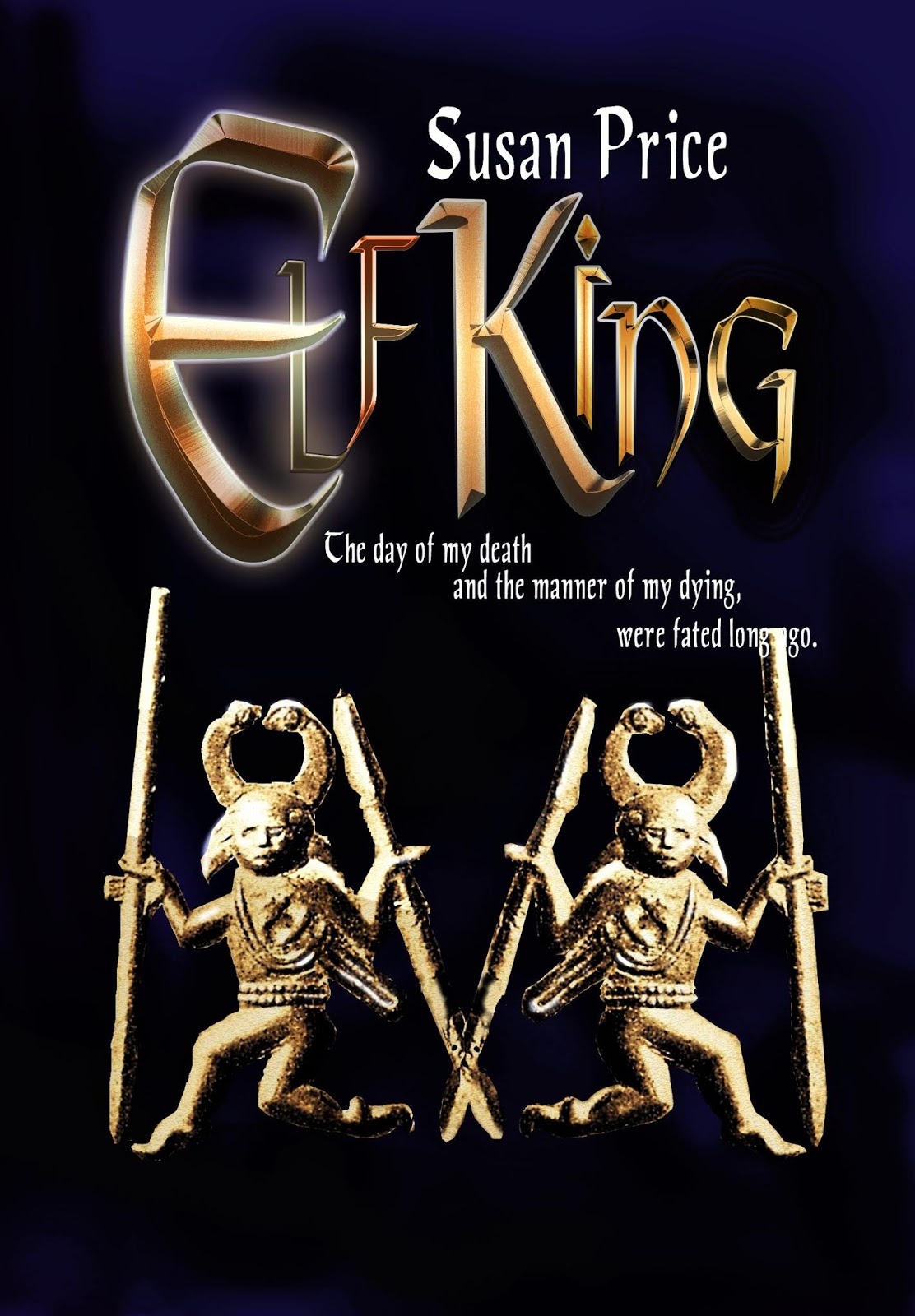
ElfKing would have been out sooner if I could have tracked down a better image for the cover.

I tried using another wikimedia image from the Sutton Hoo hoard... the famous 'man between wolves' from the purse-lid. The original is infilled with scarlet enamel and some think it represents the god Odin (who is a character in ElfKing.)

Trouble was, the rounded shape of the jewel just didn't work with the rectangle of the cover. No matter how I enlarged it, or moved it or the lettering about, the rounded shape just looked wrong.

Besides, my brother said the man 'had a silly face.'

So I used another image, one taken from a helmet plate. The book contains a couple of characters who are almost a Norse version of the Greek 'Heavenly Twins.' (There are some hints that Norse Myth did once have twin brother gods, a little like the Gemini or Dioskouri.)

 This works a little better as a design, I think but although the prancing warriors are authentically Viking Age, they are, well, a bit silly.

Just a bit. With their chubby little legs.

I decided I just had to get a cover done and stop messing about with PhotoShop. So I decided on a sword.

As my colleague and friend Katherine Roberts remarked a couple of days ago, a sword isn't a very original image for a fantasy cover. But it says, clearly, 'This is a book with sword-fighting in it. And if you like books with sword-fighting, you might like this.'

Sometimes, you just have to get on with stuff.


After all the work I put into the gold lettering, I decided that the plain white lettering looked much better. So much so, that I went back and made the lettering on Elfgift plain white too.

The slogan on the front of the book, says, 'The day of my death and the manner of my dying were fated long ago.' This isn't really mine. It's a deliberate misquote from the Norse Myths. The god Freyr sends his servant, Skirnir, on a dangerous mission into Giant's Home, to demand the beautiful giantess, Gerd, in marriage. Asked if he isn't afraid to make such a journey, Skirnir replies, why should he be? The length of his life and the day of his death were fated long ago. If he's fated to die in Giant's Home, he will. If not, not. His being afraid won't make any difference to Fate.

Ghost Drum by Susan Price
(I used the first part of Skirnir's reply in Ghost Drum. Skirnir says: 'Fearlessness is better than faint-heart for any man who puts his nose out of doors.' In Ghost Drum it became, after various rewrites, it bcame the homelier, 'Whenever you poke your nose round the door, pack courage and leave fear at home.' 

The Norse Myths have been a constant inspiration for me. I don't know if I would even have become a writer if I hadn't collided with them at eleven.)

Oh well. The next task is to get the books up as Kindles. If I can remember how.


Buy Elfgift
                 Paperback
                 e-book 


  Buy ElfKing
                 Paperback
                 e-book 


Buy Ghost Drum
                 Paperback
                 e-book 


Wednesday, 30 May 2018

Wolves and Monsters

Scotland's top-knot
When this blog appears I shall be nowhere near any electrical device capable of displaying it. I shall be right up in Scotland’s top-knot and while I’m up there, intend to visit Morag. She’s Nessie’s little known sister, who keeps herself to herself in Britain’s deepest stretch of inland water, Loch Morar. The most reported sighting of her was in 1969 when two local men ran into her, literally, while messing about in a boat. One of them hit her with an oar and the other fired his rifle at her— whereupon Morag sank beneath the water and I’m not surprised.

The men described her as being brown with rough skin, nine meters (thirty feet) long and having three dorsal humps. They said her head was thirty centimetres (a foot) wide and she held it forty-six centimetres (18 inches) out of the water— until they so rudely interrupted her.

The most recent sighting of Morag was in 2013, by two holiday-makers, who claimed to have seen her three times in two days. If I’m lucky enough to meet her, I shan’t offer her violence or even take her picture— I shall try to interest her in a copy of my Odin’s Monster. My monster isn’t one of Morag’s relatives— though perhaps I should consider writing about one of them. I don’t really know why I haven’t written about a kelpie that transforms itself into a long-backed horse, lures people into riding it and then carries them into deep, cold water and eats them. The legend has definite appeal. But so many monsters, so little time…


Odin's Monster by Susan Price
The monster in Odin’s Monster is a ‘Sending.’ This is an Icelandic concept of monster-ness, because the book is loosely based on an Icelandic legend, Thorgeir’s Bull. The wizard, Thorgeir, was supposed to have lived in the 1800s but I moved it back in time and set it during the Viking Age because, well, I like the Viking Age.

A 'sending' was created by a witch or wizard in a bad mood. At its simplest, the witch or wizard murdered someone, in order to enslave their ghost and ‘send’ it against whoever it was they had a grudge against. Hence the name, ‘sending.’ I used this idea again, in another book, ‘The Ghost Wife.’ Once created, a sending like this could plague a whole family for generations.

The sending or monster in Odin’s Monster, is a kind of super-sending. It’s the dead body of a bull that’s stuffed full of other ghosts— of a man, a woman, a child, an eagle, a bear and others. The monster can appear as any of the ghosts trapped inside it. It can fly like an eagle, roar like a bear, speak with a woman’s voice. In the original legend, Thorgeir is a kind of
stalker with magical powers, which is a frightening thought. He creates his bull to torment the woman who’s turned him down. And her family. For generations.

The Ghost Wife
One detail of the legend that I liked is that, although the bull was said to be ‘devoted’ to Thorgeir, if it ever failed in a task he’d set it, then it rushed home and attacked him instead, sometimes even trying to kill him. I used this in my own story: ‘This is the difficulty of making Sendings. Once you’ve made them, they aren’t easy to control.’

Instead of tormenting a woman, I have my wizard, Kveldulf Witch, torment a story-teller named Thord Cat. He wants Thord Cat to tell the story of his life, of all his murders and double-dealings, of which he's very proud.

But Thord Cat dislikes the witch and refuses the commission. (The pay's rotten anyway.) Appalled by this cheek, Kveldulf calls on his god, Odin, to help him in creating the monster and he sends it against Thord Cat, to try and force him to do what Kveldulf wants. Every time the Sending arrives at the farmstead in one of its guises, it demands that Thord Cat tell its master’s story. On ‘the third time of asking’, if he refuses, it will kill him.

This story for 8 to 11 year olds was first published by A & C Black in 1986, so long ago that I can't believe it. Over the years I’ve had a lot of fun reading the story aloud to children in schools. I still do. It never fails to have them leaning forward in their seats, with open mouths and wide eyes. After Thord Cat’s second refusal, the sending, in its woman shape, says, “Next time I come horned.” I always break off there and say, “If you want to know how it ends, you must read the rest yourselves.”

This usually brings on groans and pleas for just a hint of how it ends, a clue… Teachers have sometimes had children write their own ending for the story before they read it to them.

The Wolf's Footprint by Susan Price
My indie best-seller, by a long way, is The Wolf’s Footprint, which is aimed at a similar age-group. So I thought I should unleash my sending again and send it out into the world, coupled with Wolf’s Footprint. I got my brother, Andrew, to do some new illustrations for Monster in exchange for a cut of the overwhelming riches which will doubtless flood in as soon as it goes on sale.

I put together the cover of Odin's Monster, using one of Andrew’s illustrations. The cover’s okay, but I will probably tweak it a little, now I’ve held an actual copy in my hand. I have a couple of other back-list books written for a similar age-group, which I aim re-issue this year.

In the meantime, I’ve just heard that Kate Stilitz’s brilliant musical version of The Wolf’s Footprint is to be staged again, at Tiverton Primary in London— and I shall be going to see it. Looking forward to that enormously.

The Wolf Pack (in Kate Stilitz's production)


Odin's Monster


         The Wolf's Footprint


Monday, 26 March 2018

Review: 'The Lost Words' by Jackie Morris and Robert Macfarlane


This book really doesn't need any help from me. It's already a classic. But I wanted to review it because I love it.

I wanted to read it from the moment I first heard how it was inspired:-- during one of the regular revisions of the Oxford Junior Dictionary, it was decided to exclude certain words, which modern children no longer looked up or needed-- words such as 'bluebell', 'heron,' and 'conker'-- in order to make room for words such as 'broadband' and 'wi'fi'.

The book's wonderful artist, Jackie Morris, was incensed by this. She tells about how the book came about here. (The beautiful picture at the top of this blog is from Jackie's site.)

Many other writers and artists were aghast when they heard about these words being dropped. There is a theory of language that says that when you lose the word for something, you also lose the ability to think about it or consider it important. It becomes something nameless-- and if people haven't even bothered to name something, it can't be important, can it?

Theory apart, how the hell can you dispense with the word 'bluebell'? Every year I go to view the miles of bluebells in the woods on the Clent hills. Somehow, it wouldn't be the same if I walked there thinking, "What a lot of blue flowers."

Rather, when I look down a slope covered with blue and see the blue spreading and filtering through the trees, it adds a lot to know that these are bluebells, wild hyacinths and that such masses of them indicate 'undisturbed ancient woodland.'

But how can  'heron' ever  be considered a word that isn't  necessary in  a children's dictionary? Or dandelion? Dandelion, for god's sake. Dandelion piss-the-bed: dandelion clocks-- how do you even be a child without knowing the word dandelion and what it represents? As well get rid of 'daisy' or 'buttercup.'

I had been trying to work out how to get my paws on a copy of the book, since its beautiful production makes it expensive... While I was still wondering, I saw a tweet from Jackie Morris herself, commenting in surprise that the third Sterkarm book, A Sterkarm Tryst, was in print.

I have a slight aquaintance with Ms. Morris-- I wouldn't presume to claim it to be anything more. So I tweeted back with a suggestion that we do swapsies. I would send her a copy of Tryst (wot I wrote) if she would send me one of The Lost Words.
A Sterkarm Tryst

I think I got the better end of the deal. The book arrived in the post some weeks ago and I have kept it to hand and dipped into it frequently ever since.

It's a much larger book than you might guess from the picture above. And it isn't a book of poems with illustrations. The artist and poet are equals here-- the initial idea came from Jackie Morris and she tells us how writer and artist influenced each other.

Robert Macfarlane, a prize winning poet and writer, has written 'a book of spells'-- the intention being to spell the lost words back into our memories and useage.

Each spell is introduced by a double-page spread where letters blow and tumble among grasses or fern or trees-- as if the lost words were being broken and scattered. Or, perhaps are being called back, spelled back together.

The poems are acrostics, so the word in danger of being lost is spelled, not only in the title, but in the reading and writing of the spell. And the poems are beautiful. The more often you read them--spelling back those lost words-- the more beauty you find in them.

Facing each poem is one of Jackie Morris' rightly celebrated paintings. And then, over the page, a double spread painting-- paintings of acorns, brambles, owls, bluebells, magpies...

 I love the whole book, but I think my favourite part is Bluebell. The beautiful poem is followed by a breathtaking double page showing an owl fleeting and a fox slinking through the dusk of a bluebell wood.

But otters, ravens, newts, willow, adders-- you'll find them all here. Magpies too. I love the magpies who 'gossip, bicker, yak and snicker' in my garden. Love their flying dinosaur shapes, their long tails and petrol blue sheen. Currently they are pulling my hedge to bits for nesting material and flying off towing long streamers of dried grass behind them.

"A proportion of the royalties from each copy of The Lost Words will be donated to Action for Conservation, a charity dedicated to inspiring young people to take action for the natural world.... www.actionforconservation.org"

In Scotland, Jane Beaton has raised £25,000 to give the book to all 2,681 schools in Scotland-- for more about this story, follow this link.


Susan Price is the author not only of A Sterkarm Tryst, but also of The Sterkarm Handshake and A Sterkarm Kiss-- as well as about 60 other books. You can find out more about them on her website, here.

Saturday, 27 January 2018

Thank you, Lev Butts. You have been an inspiration.

     My Authors Electric colleagues are always being inspirational and Lev was the latest one at it. Before Christmas 2017, Lev did a blog on ideas for presents to give the writers in your life.
     One of Lev's gift ideas was a book on cover design: Cover Design Secrets Bestselling Authors Use to Sell More Books, by Derek Murphy. (Oooh, those sneaky best-selling authors with their secrets. Murphy is no slouch on 'exactly what it says on the tin' titles either.)
     Lev's blog seems to have been quite a success, since just earlier this month, another AE, Reb MacRath was having a bit of a rave about another of his recommends, Arc customisable notebooks.
     But since I've been spared the notebook obsession that seems to strike so many writers, it was the cover design secrets that grabbed me. It had been nagging in the back of my mind for quite some while that not all of my covers were as, well, grabby as they could be.
      What were those secrets that best-selling authors were hogging to themselves? I needed to know.

     I ended up looking into several books on the subject. Look up Murphy's book on Amazon and you will be shown several others covering the same ground.
     What did I glean? -- as my Scots partner always puts it.
     Well, I'd always known that the cover needs to show the would-be reader the kind of book they'll be getting, whether it's humourous, romantic, historical, thrilling adventure or blood-thirsty crime.

     But this is a factual approach. Here you are: there's a castle and someone in historical clothing on the front: it's historical. Or, there's a fast modern car and a gun, so it's contemporary and a thriller.

     I think what I'd failed to grasp -- surprisingly, considering how I've made my living -- is that there needs to be an emotional connection too, just as in story-telling.
     When we write, we most often start with something that shows the reader the character they'll be connecting with. We construct a scene that lures the reader into identifying with that character, that creates an interest in them. So a cover needs to say, not only: This is X kind of book. It has to also say: Don't you want to know more about this person?

Years ago I was commissioned to write a story set in the Viking Age. The publishers wanted something pacey and exciting but historically accurate. After it went out of print, I republished it myself, and this is the cover it had. (Art work by Andrew Price.)

I looked at it again, and considered it in the light of what I'd been reading about book design. Despite all the axe and sword waving, it seems a little aloof and distant. It says: This is a book set in a time when blokes went about in helmets and mail, looking for trouble.

But there's a bunch of them. Milling. Which one are we supposed to be rooting for?

So I fired up PhotoShop and made some changes.

 Saga of Aslak Slave-Born by Susan Price


This new cover gets in close and personal and leaves no one in any doubt about which one is Aslak, our main man. It also reminds me of the quote from Sellar and Yeatman's 1066 And All That
 'Britain was attacked by waves of Picts (and, of course, Scots) who had recently learnt how to climb the wall, and of Angles, Saxons and Jutes who, landing at Thanet, soon overran the country with fire (and, of course, the sword).'


Another book of mine which I felt was not being sold by its cover was The Bearwood Witch. 

Andrew and I, in designing the cover, had been puzzled what to put on it. There's a witch but it's set, not in fairy-tale forests, but in one of today's grimy inner cities. How to tell the reader that, visually?

We came up with this, but neither of us were very happy with it.

The door-key was supposed to suggest the present day, while the five-pointed star stood for witchcraft. It's quite eye-catching and graphic, but who builds an emotional connection with a key? It doesn't give the reader much idea of what to expect.

Again to PhotoShop. (I know, Karen, I know about PicMonkey but just as the shortest way to a destination is the way you already know well, so is the shortest way to a new cover.)


The Bearwood Witch by Susan Price


I think the new cover (left) does a far better job of connecting a browser with the book and what they can expect from it. Darkness settles over a street of parked cars and terraced housing as we are eyeballed by one of the main characters.

I also discovered that I'd neglected to publish Bearwood Witch as a paperback -- well, that's put right now.


The title of this blog is, of course, inspired by all those ads that keep popping up while you're browsing on-line, with either 'the UK' or the name of some town local to you inserted: Oldbury is going mad for this diet plan!  Smethwick is going crazy for these incontinence pads!

Well, the UK as a whole does seem to have gone a bit giddy just lately but I can assure you that neither Smethwick nor Oldbury goes mad for anything.

Except these books. The UK is going mad for them, I tell you. Mad.
__________________________________________________________________________


This is the saga of Aslak Ottarssen, born a slave.
Aslak, and his beloved sister, Astrid, are the children of a Norwegian farmer. Their mother was an
English slave.
     Their father chooses to free Aslak. But Astrid remains a slave.
     Aslak promises that he will buy her freedom when he is a man and can earn enough silver. At fifteen, he goes viking to earn his fortune.
     Returning from sea, he finds that his father has died. Worse: his step-brothers have sold his sister.
     Furious, Aslak leaves his home forever, and calls on his ship-brothers to help him find and free his sister.
     He pursues Astrid across the North: a violent and dangerous place in the Viking Age. His hot temper leads to him being sold into slavery himself, in Jorvik, capital of England's Danelaw.
     But, captive among strangers, he finds unexpected help, faces death, sees a ghost— and meets still more danger.
Can Aslak regain his own freedom and rescue his lost sister?
 Kindle              Paperback


Zoe wants her dead boyfriend back. 
She's heard all about Elizabeth Beckerdyke. About her being a witch. About her speaking to the dead.
     Maybe she can raise the dead too?
     So Zoe goes knocking on the witch's door.
                Duncan is homeless, a rough sleeper.
     He's looking for a new life. He fears the witch and he fears for Zoe.
                Elizabeth Beckerdyke wants to prove her power.
     But can she control what she leads back from the land of the dead?

                A dark, disturbing novel of the occult by the award-winning author of The Sterkarm Handshake.


Kindle             Paperback


Saturday, 19 August 2017

Crofting, Seaweed and Iodine

Crofters in the Highlands and islands of Scotland have always had a hard life. Even now, although crofting may be a more rewarding way of life, in many ways, than banking or sales, it’s by no means easy.

In a past stretching back into pre-history, crofters supplied almost all their own needs by their own labour: building and maintaining their steading, raising animals to provide meat, milk and wool, making their own clothes and making or repairing their own tools. They grew oats and vegetables but also fished and gathered wild food.

Almost always, a crofter had to pay rent to the owner of the land they farmed, and that rent had to be paid in hard money. Cash was often needed to supply a few needs they could not make, catch or grow for themselves: a little tobacco, perhaps or raisins and spices for Christmas.

One way to earn money was to drive their cattle to the markets where the highest prices were paid. Another, which I learned about when I researched my book The Drover’s Dogs, was to burn kelp.

Kelp, wikimedia, By Bjørn Christian Tørrissen
Kelp is a large and fast-growing seaweed which forms thick kelp forests around rocky coasts. It had been gathered for centuries. Crofters carried it from the beaches on their backs in tall baskets— a heavy load, often carried up steep, hazardous cliff paths. It was spread on fields as fertiliser.

There was also a tradition of burning the kelp to ash and mixing the ash with fat to make an ointment. Because of kelp's high concentration of iodine, it was a quite effective antiseptic.

With the rise of industry, iodine became a far more valuable commodity. It was used in glass-making and pottery as a colouring agent. The cloth trade needed it for bleaching linen. Soap makers used it to turn soap from messy goo into the hard blocks which customers favoured. Iodine was also used in the production of the cleaning agent, soda.

It was easier to import kelp from Europe than to fetch it from the far more remote Scottish Highlands and islands, but European kelp was heavily taxed. So agents made difficult journeys north, offering to buy all the iodine the crofters could produce. Kelp was harvested in Ireland too.

A crofting family would build a kiln. These varied considerably: some were built above ground, somewhat resembling an oven. Others were simple pits. Some, if the crofters could afford it, had an iron grid laid above the pit, on which the kelp was placed and burned.

Kelp was gathered throughout the year, especially in the winter after storms, which tore it from the rocks and washed it up. The seaweed was spread to dry and then piled into stacks, in kelp-ricks which were thatched with heather to keep it dry.

Burning started in June, while the men of the crofting family might be away on a drove. The dried kelp was piled on the iron grid over the pit and set alight.

Crofters burning kelp in Stronsay - Glens of Antrim Historical Society
As the kelp burned to ash, the oil from it dripped into the pit. The smell of the burning seaweed was, it seems, exceptionally powerful and pungent and carried for miles. If you can recall the rank stink of exposed estuary mud on a hot day, imagine that burning and, it seems, you will have a faint idea of the stench.

The end result was a pit full of thick, stinking oil which cooled to a rock-hard substance of greyish, purplish blue. If allowed to go cold, it had to be chipped and chiselled out of the pit, so the burners tried to dig it out before it was completely cold, while it was still easier to work. The iodine blocks were heavy and it was hard, stinking work.

Agents bought these blocks and paid good money for them— though in some parts of Scotland, all the money from the trade went to the local laird. Who did none of the work.

But for those who did profit from this hard, dirty, stinking labour, it was another source of ready cash and for about fifty years, roughly between 1780 and 1830, business was good.

However, in the 1820s, the tax on European seaweed was reduced, and the tax on salt  abolished. This made it much cheaper to import seaweed from Europe and much cheaper to make soda from salt than from kelp. These decisions, made in a southern parliament on behalf of southern industries, destroyed the kelp industry of the Highlands and islands.

It also contributed to depopulation of the Highlands because, at the same time, the droving trade was being killed by railways and landlords were raising the rents of crofts. Caught between rising rents and falling profits, many Highlanders left for Canada and America – where, in dreams, they beheld the Hebrides.

After 1830, demand for iodine from Scotland rose again as industry began producing aniline dyes and photographic plates. The seaweed from Europe was no longer enough, and agents once more came to the Highlands. But the industry was never again as strong as it had been, since so many of the people who would once have collected and burned the kelp had left the crofting life - either by choice or eviction.

This gave me an ending to my book The Drover’s Dogs, whose narrator is a Scot telling his Canadian children how he was rescued by two herd dogs and 'brought home' to Mull.

The Drover's Dogs by Susan Price
The ending rose partly from my own research and partly from the research my Scots partner did into his own family. He had a special interest in Drover's Dogs, since he helped me follow the old drove road to Mull, told me of the 'bondage,' the young hero escapes and also painted the cover picture! (And he doesn't like what I've done with it.) Since a branch of his own family had gone to Canada and become quite wealthy farmers, he was quite keen that the family in the book did too.

So I gave him the ending he wanted, to make up for what I did to his painting

Find The Drover's Dogs on Amazon.