Showing posts with label Iona. Show all posts

Saturday, 27 July 2013

How The Collie Dogs Rounded Up A Story


'Some years ago the late Miss Stewart Mackenzie of Brahan, Ross-shire, informed a friend that in the course of journeys by coach in the late autumn from Brahan to the South during her childhood about the year 1840 she used frequently to see collie dogs making their way north unaccompanied. On inquiring of her parents why these dogs were alone, [she] was informed that these were dogs belonging to drovers who had taken cattle to England and that when the droving was finished the drovers returned by boat to Scotland. To save the trouble and expense of their transport, the dogs were turned loose to find their own way north. It was explained that the dogs followed the route taken on the southward journey being fed at Inns or farms where the drove had 'stanced' and that in the following year when the drovers were again on the way south, they paid for the food given to the dogs...'
          I've more than once found inspiration in footnotes. The one above is taken from 'The Drove Roads of Scotland; by A. R. B. Haldane. I read it years ago - at least ten years ago. Those dogs were always trotting about at the edges of my mind.
          Then they met up with the workhouse apprentices I'd read about thirty years ago. For centuries the apprentice system had put a boy to work for a craftsman. In return for his free labour, he recieved food, board and clothing, and a training in a trade.
          With the industrial revolution, this system was corrupted to
provide cheap labour for mills and factories. Pauper children were 'apprenticed' to the mills, where they were set to work for long, long hours in return for the cheapest food and clothing. They learned no skills, except the operation of machinery. At night they were locked up. They were, in everything but name, slaves. Their 'apprentice papers' bound them to the mill-owner until they came of age.
          What, I thought, if a child escaped from this slavery and, in running away, met up with a couple of collie dogs returning home to Scotland? The collies round him up, and as they provide protection and companionship, and he has nowhere else to go, he decides to walk with them wherever they take him. The dogs are heading west, to their home-croft on Mull, but the boy doesn't know that.
          I found out my copy of Haldane's Drove Roads and consulted it. The drove route from the Isle of Mull to London was the one that seized my imagination. There were longer roads - cattle were, in historic fact, brought from the Outer Hebrides and driven down to London, but I decided not to tax modern readers' credulity.
          My partner Davy, being a Scot of Highland descent, took a more than usual interest in this plotting. "It's too long," he said. "You've got to get them all that way. Why not keep it simple and have the dogs on their way back from the market at Falkirk?"
          I don't always take his advice - it's his constant complaint - but on this occasion, I listened. 'Keep it simple, stupid,' is a good rule of thumb.
          But if the boy was walking from somewhere near Falkirk to Mull, the dates wouldn't work too well for him being an escapee from factory enslavement.
          When I said this, Davy told me what he knew about Scotland's 'bond-women' who wore an odd 17th century costume, and were 'bonded' to work on farms right into the early 20th century. Sometimes boys were bonded too, and it was a pretty harsh system. Davy told me of a boy he'd read of who'd been over-worked, under-fed, and made to sleep in a damp shed with thistles growing through his pillow. He'd escaped his bond by enlisting in the army when WWI broke out - and while everyone around him thought barracks life was harsh and the rations short, the bond-boy had never known such luxury in his life.
          So there's my boy, walking west with the dogs, following the drove road out of English speaking Lowland Scotland, into Gaelic-speaking Highland Scotland. I don't know a word of Gaelic. I don't know much about Scots history - nor, unfortunately, do I know a man who does. Davy says, 'They don't teach English history in Scots schools, and when they taught Scots history, I wasn't listening.' Why does my imagination never give me anything easy to do?
          But at least, thanks to Haldane, I know the route he and the dogs would have taken - and last week, Davy and I were up in Scotland, checking it out. And getting bitten by midgies (Davy) and by cleggs (me.)
          We went to the old ferry crossing on Loch Awe, where the drovers took their cattle across.
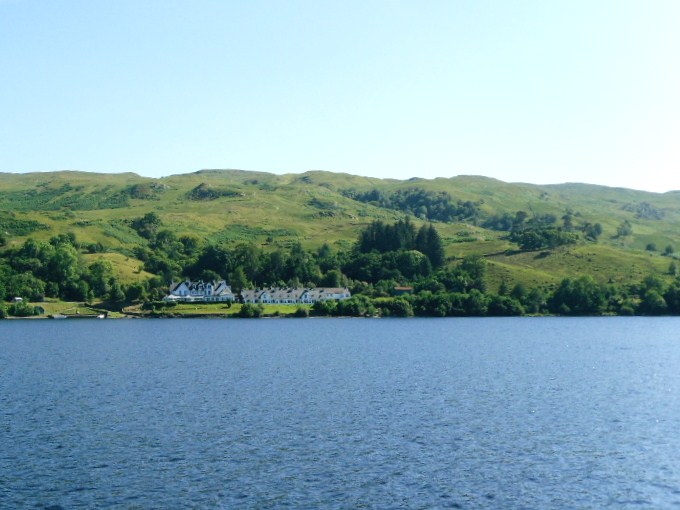
          This is taken from Taychreggan. The building is a modern hotel, but it's situated where the old droving inn stood. The drovers took their cattle across here, and then climbed the hills beyond, heading for Loch Fyne.
          The modern hotels here are pretty swish and exclusive. They take some finding for one thing. It's not casual passing trade they're relying on. The thronged drovers' inns were about as unlike them as it's possible to be. Dr. Johnson gave them terrible reviews on his equivalent of TripAdvisor. They were, according to him, damp, dirty, flea-ridden and with filthy food. But as the drovers lived on oatmeal mixed with water, milk and blood, their taste was robust.
          From Taychreggan, as Davy was feeling strong, we took the road less travelled, via Glen Nant and Glen Lonan, to the town of Oban. So we came in over the hills, as the drovers would have done.
          The journey was beautiful, but only for drivers of strong nerve. The sheep don't help, as they lie in the road, toasting their little trotters on the hot tarmac, and giving not a spit for tourists in cars. The mountains - ('Hills,' Davy says, 'they're hills.') - the mountains rose above us and leaned over, peering down like giants. It gave me a vivid feeling of how my wee boy would feel, lost in that landscape, and how glad he would be of the dogs' company. The Highlands were more populated then, with many crofting communities. Even so, it would have been no walk through a park.
          Here's Oban.

          The green island in the foreground is Kerrara, which safeguards Oban's harbour.Rising up behind it are the mountains of Mull. It's quite hard to imagine Oban as it would have been at the turn of the 18th-19th century. The whisky distillery - one of the oldest - would have been there, and the castle, obviously. 
          Over on Mull, we visited Grass Point, which is where the cattle and drovers left the island. The cattle were taken by boat over to Kerrara, walked the length of this small island, and then swum across the narrow strait to Oban. We tried to pin-point where this was, and decided that it must have been near where the castle stands. 

          Here's the old ferry house at Grasspoint on Mull - today it's another remote place to stay on holiday. If you like holidays where the only night-life is provided by midgies.
            We ended here, on Iona, so Davy could walk in the footsteps of the great Scottish colourist, Cadell.


I am entirely with Blott. If he comes round to mine, he can have Republican sanctuary with a warm dry cushion and cream.


Saturday, 2 June 2012

Of Lambs, Scones and Blind Summits


Iona
          I spent last week in a place of sugar-white beaches and palm-trees, turquoise sea, all-surrounding bird-song, blue skies unmarked by any wisp of cloud, and air-shaking, tarmac-melting heat: the Highlands, Scotland’s west coast.
          We drove to Oban and caught the ferry to Mull. I love ferries, especially little everyday working ferries.  There was a Scottish Water van and a plumber in the queue, and I wondered whether, when they were given their work-sheets that morning, they thought: Oh great! I’m going to Mull! They probably did in this weather, Davy said.  But in January, not.
Iona's cathedral
          On Mull we drove the length of the island to catch the passenger-ferry to Iona.  It was so hot on the island, we were glad to go into the shade of the beautiful cathedral.  While walking through the fields we heard corncrakes – I recognised the call from my Dad’s description: ‘Like a stick being dragged across railings, or a football rattle being shook slowly.’  He used to hear them, as a boy, in the fields around his house, but those fields have long vanished.
          We stopped for a drink at the Argyll Hotel, which served the best scone and coffee of the whole trip.  We sat in a sunny garden, beside a richly scented rose-bush, looking at a white beach, blue sea, and the mountains of Mull beyond.
          I dropped a few crumbs, but they were cleared by an unusual waiter (right).
          We stayed the night at a B&B on Mull, where the landlord didn’t give us a key because, ‘we never lock anything up.’
          We crossed back to the mainland from Tobermory (or ‘Tobe’ as the locals seem to call it), and spent most of the next two days on the most beautiful beaches that could be imagined.
          Everywhere was what Davy called ‘great lumps of scenery’.  I’m not sure exactly what constitutes a great lump of scenery, but you won’t go far wrong if you include at least one loch, a dozen mountains, a quantity of boulders and burns and any amount of blue sky.  As a bonus, throw in a beach and a couple of deer.
A great lump of scenery
          There was so much beauty that, at the end of a day, I was exhausted, and longed to sit in a dark room, stuffing my face with pot-noodle and watching ‘X-Factor’ as a corrective. But after a night’s sleep, I was eager for more scenery lumps.
          But the roads! The signs say ‘single-track’ and they do not kid. They are so narrow there isn’t room for a car to pass a cyclist.
Passing-places are provided, on alternate sides.  If the nearest passing place is on your side, you pull into it, and wait for the other car to pass.  If it’s on the alternate side, you stop opposite it, and the other car uses it to pass you.
          At least, that’s how it’s supposed to work, and with locals, it works very well.  However, journeys are enlivened by foreign tourists, who don’t understand the system, or feel more comfortable driving on the left, and instinctively dive for it in an emergency.  A motorcyclist, for instance, shot across in front of us, into the passing-place Davy was just about to enter.
Another lump of scenery
          A huge camper van sat in a passing-place, watching us approach, and as soon as we were nearly level with him, pulled out, entirely blocking the road.
          Another couple made angry shooing motions at us, telling us to reverse, when the nearest passing-place was on their side, immediately behind them.  Our nearest was a considerable distance back along a winding, hilly, narrow road with a steep drop on our side.  Davy wasn’t budging, shoo as they liked, and it was they who reversed – having caused a minor queue. Not easy on roads so remote and quiet.
          The roads were so narrow, with so many blind hilltops, hairpin bends and deep dips that the road often vanished like a magic trick.  You reached the top of a rise, to see the last of it whisking round a lump of scenery, leaving nothing before you but moor. 
          Potholes had crumbled the road’s edges away, and there were drops and ditches at the sides… We had to develop a system where Davy, driving, kept his eyes on the road immediately in front of the car, while I watched as far ahead as possible (a glimpse of road sometimes reappeared in the distance) so I could forewarn him of approaching vehicles.
          After many miles of this, we passed a shiny new road sign: ‘Beware: Blind Summit.’  Workmen had been despatched from some distant depot to erect that sign.  Beyond it were miles and yet more miles of difficult, blind, narrow hairpin bends and blind summits, where sheep, cattle, motorcyclists and camper vans lurked unseen.  Why that particular blind summit deserved its own sign, we never discovered.
          But it was a great trip, and even on the morning of the day we returned, we brewed up on great slabs of rock by a waterfall, and enjoyed a coffee-break that no cafe or hotel could equal.
         I took many photos, but there were some sights I missed and wish I hadn’t…
         The enormous – HUGE – red, shaggy Highland cow standing at the roadside in a lowering glen (hey, embrace the cliché), its horizontal horns so wide that a single horn nearly spanned the narrow road.
         Two small lambs asleep on a moorside verge, their legs intertwined and wrapped around the pole of a ‘passing place’ sign.
To distract Madwippet from a mention of a cat.
         The ginger cat splayed on the pavement of Tobermory’s high street, abandoning itself utterly to the hottest sun it had probably ever known in its short life.
         But the lost photo I regret most is of the sweeps of bluebells spilling down to the loch sides.  So I tried to put the scene into words instead:

Brawling bluebells,
                       Vibrant, cobalt,
Run to the lochside,
                            Steel-blue, cobbled;
The mountain’s wall,
                Tawny, bony:
And the sky
                Lark-pierced,
                                                   Cerulean,
                                                                            Still
                                                                             Lonely.

And the palm-trees?  They do grow in the west of Scotland, where it's warmed by the Gulf stream.