Showing posts with label Edinburgh. Show all posts

Saturday, 5 December 2015

A Spiritual Revelation: Single Malt Whisky

Comedian Rich Hall
I once saw the comedian Rich Hall addressing an audience. He asked if there were any Scottish people in. Answering roars told him that some people came from Edinburgh
          "Ah, Edinburgh," he said. "I once had a spiritual revelation in Edinburgh. It was called, 'Single Malt Whisky.'"
          I feel much the same, though my spirituous revelation didn't happen anywhere in Scotland - and it happened well before I met my Scottish partner. I was already a faithful drinker of single malts by the time I met the Scot.
          It was another man who, one evening, asked me what I was drinking. "Whisky." I said, and his interest was piqued. Which whisky did I favour? - and he reeled off a few of the single malts.
          "Oh, just get me a whisky," I said, in my ignorance. "Doesn't matter which one - I don't believe in all that marketing hype about single malts."
          He was offended. It was not mere marketing hype, he said. A single malt was vastly superior to the cheap, blended stuff. It was made in the place it was named after, from local water and grain. It was lovingly aged - and ya-da-yah, as I thought then, he spouted all the marketing rubbish about sherry and oak casks.
          "It's just branding," I said. "It's just an excuse to charge more."
          Allow him, he said, to do me a kindness and prove me wrong. Allow him, if I would, to buy me a couple of different single malts. Taste them, and then tell him that there was no difference between them and the likes of Jack Daniels, Bell and Johnnie Walker.
          Well, okay, I said, if you're paying.

          I always liked whisky best, of all spirits, ever since I used to sip from older relatives' glasses as a child. But whenever I drank it, the harshness of the alcohol made me shudder to my toes. That was the price, I thought, of liking whisky. You had to put up with the shudder.
  
        I can't remember which whiskys the gentleman bought me. Since he knew he was dealing with a beginner, it was probably a couple of the softer ones. Maybe a Glenfiddich or a Glenlivit for one - they are light, pale yellow and have a lemony, citrusy taste. And perhaps a richer, fruit-cakey one, aged in sherry-casks, such as an Aberlour.
          And it was a spiritual revelation. I drank and I didn't shudder. I realised what 'smooth' means, when applied to spirit. The single malts were so well made and aged that they slipped down with nothing more than a warm glow - and a wealth of flavours.

          Once you're converted, there are so many to try! Jura, Auchentosh, Glenmorangie, Talisker, Dalwhinnie, Craganmore...
All of them a little different. When I did meet the Scot, he told me that his father had been a whisky cooper, and in the course of cooping barrels for many different distilleries, had sampled many, many different whiskys. It was his experienced and considered opinion that the best of them all was a 10-year old Macallan. It didn't, to his taste, improve for being 12, 15 or 30 years old. The ten year old Mac: that was the one.
          And it is excellent - as is Bushmills Irish single malt, though the Scots of my acquaintance frown on Irish whiskys (and, for that matter, American and Japanese 'whiskys.' If it's not from Scotland, it's not whisky, is their thinking.)
          Personally, though, after years of trying different single malts, I'm coming to the conclusion that the best of the lot is, as many agree, Islay's Laphroig. (It's pronounced 'La-FROYg.)

          Scots friends have put forward Lagvulan as their favourite. It's very good - I've yet to meet a single malt I didn't like - but good as it is, it's not Laphroig. 

          I didn't think so when I first tasted Laphroig, years ago. I thought it smelled and tasted like burning rubber or kippers. I much preferred the lighter malts, like Glenfiddich or Oban. Or Highland Park from the Orkneys.
          But, gradually, I learned to like it. Peat smoke and honey is one of those poetic tasting descriptions for Laphroig, and the last time I drank some, I could appreciate what that meant. I could taste the sweeter honey notes coming through the harshness of smoke and iodine. I had another spiritual revelation: I realised I loved Laphroig.

          Still, it doesn't matter: mild Glenfiddich or smoky Laphroig, or spicy Aberlour, or any of the others, there is no spirit that has so much warmth and so many layers and variations in flavour as single malt whisky. I love the stuff.
          I tried to repay the gent who convinced me of the worth of single malt a few months ago. I was passing the shelf of whisky in a well known supermarket, and saw a lady looking confused in front of them. So I went over to check out my next purchase (single malts are my only extravagance) and asked her which one she fancied herself.
          She told me she knew nothing about whisky, but had been charged by her friends with the task of buying a bottle for their retiring manager - who it seemed they all liked. He was a whisky drinker, she said, so they thought a bottle of - and she waved vaguely towards the blends. But now she was here, there were so many different kinds and she was confused.
          Buy him a single malt, I said. If he's a whisky drinker, he'll be grateful. I think I steered her to an Oban in the end - a little bit smoky, but with a spicy, citrus sweetness too.

          This blog comes to you with the faint, but very real hope, that a whisky distillery will be overcome with Christmas good cheer and grant me a lifetime's supply of single malt.
          Or even a single bottle. Go on.
          Just one.
          Go on, go on.


Saturday, 30 August 2014

Flatcap Day out in Edinburgh

Edinburgh Castle - Wikimedia Creative Commons

          A couple of weeks ago, I enjoyed a Flatcap day out in
Edinburgh.
          I should explain - I'm a member of the other SAS, the Scattered Authors Society, which has a chat-board called 'Balaclava.'
          The lovely Penny Dolan (who wrote 'A Boy Named
M.O.U.S.E' which I recommend highly) started an off-shoot group, called 'Flatcap' - partly because it keeps up the head-gear theme and partly, I suppose, because Flatcap is about work.
          Its purpose is to spur on the writers who form its small membership. They have to say what it is they intend to work on, and then report on progress. It's  highly effective for most of its members, though for me, not so much. (My fault entirely, not the group's.)
          It concentrates a writer's mind wonderfully when they know they will have to report to a group of other writers, who might have written many more thousands of words than they have. Karen Bush, especially, has been powering through the pages.

          Anyway, a couple of weeks ago, I was in Edinburgh - arguably the best capital city in the UK, though it may soon be leaving us - and I was at a loose end. So I emailed a couple of Flatcappers, who I knew lived near (or near-ish) Old Reekie - Linda Strachan and Joan Lennon.
Joan

          They both put aside their own work to travel into Edinburgh and meet up with me.
Linda
          First I met Linda at Waverley Station, and we walked to the Dovecot Cafe, where Joan was already waiting. We ordered coffee and we talked, for about two hours non-stop - oh, about the fantasy Linda is working on, and the prospects for Joan's novel of the Stone-Age, Silver Skin (which I am looking forward to), and my consultancy training with the Royal Literary Fund, and Joan's poetry (which is great and we keep urging her to produce an ebook) - and agents and publishers and blogging and - 
Berserker

          Nobody could wish for better, wittier, livelier companions than Joan and Linda.
         Then we went to the National Museum of Scotland because Joan wanted to show me their stone-age exhibits (we are both keen on the Stone Age) and also those of Lewis chessmen who live there. Which included a berserker! - I bought myself a couple of replicas: one of those berserkers, and a King. I was torn between the King and Queen, but eventually settled on the King because of his beautifully combed tresses.
          And all the time we were talking...
 
King, King, let down your hair
        Linda showed us some display cases designed by an artist. I'm ashamed not to remember more, but the cases were works of art in themselves - like strange robots, with pieces displayed in boxes in their chests or arms.

          Then it was lunch-time, and Linda guided us to the library cafe - because, it being the middle of the Festival, we were unlikely to get a seat anywhere else. (We passed cafe after cafe, packed to the doors.) Once in the library, we talked and talked.
          The party broke up at about four. We all had to catch trains from Waverley - and as we rose to go, there was a flash of lightening, a clap of thunder worthy of 'Macbeth', and storm-clouds burst over the city.
          Linda and Joan had been wise enough to bring umbrellas. I hadn't - but Linda, kind as ever, shared hers with me - and also led us by wynd, close and dreel down to the station. I know Edinburgh a little, but I couldn't have found that route.
          At Waverley, Joan and I said goodbye to Linda (who got home safely, you'll be glad to know), and started scanning the trains for Fife listed on the Departures Board. Thus it was we discovered that the lightening had wiped out all the signals for Fife, and all trains for the Kingdom were cancelled. Aaargh! Joan had to get home, and I was expected back at the digs by my partner.
          Joan collared a Scots Rail 'Customer Information' Officer, and exerted her considerable charm. In moments, though surrounded by scores of anxious passengers, he wanted to talk to no one but her.
          For about fifteen minutes, all was confusion while the rain crashed on the roof above us. The signals might be restored - they might not. We might be taken to our destinations by bus - but there was no news of the buses yet. We might consider catching a train to Perth, and then finding our way south into Fife - but we wouldn't be getting to Perth until 7pm, and how did we know there would be trains into signal-less Fife? Trains. I hate 'em.
          And then, suddenly, the signals were restored, and our train - although late - was leaving from platform 18. Joan and I joined the stampede to it - and by some stroke of fortune, managed to find seats together.
          So, on this Scottish trip, I crossed the Forth both by the road bridge and the rail bridge, which I count a plus. Always a thrill to see the magnificent Forth bridges, and to recite, 


'Oh, beautiful Railway Bridge of the Silv'ry Tay!
Alas! I am very sorry to say
That ninety lives have been taken away
On the last Sabbath day of 1879,
Which will be remember'd for a very long time.'
McGonagall.


In banana pose
          Even plusser, I had Joan Lennon by my side, who pointed out seals on the rocks 'in their banana pose.' A trip across the bridge was a trip incomplete and wasted unless a seal was spotted, according to Joan. I have to agree.
          I got off before Joan, and trudged back to the digs through the pouring rain - my partner had taken the car to Glasgow. I watched rain fountaining up through the lace-holes of my shoes at every step - something I haven't seen since walking home from primary school through the downpour that seemed a permanent feature of my childhood. (Other people remember eternal summers: but I remember grey, cold days with water rattling down the gutters, splatting on my head and spurting out of my lace-holes.)
          But the day out in Edinburgh was a great success. Thank you Linda and Joan, for giving me your company, many laughs and much kindness.

Photograph of the seal - GeographBot, Wiki Commons
Photographs of Lewis Chessmen, National Museum of Scotland, Wiki Commons.


Saturday, 10 August 2013

A Book Festival Round At Yours...


     Starting on Monday, we're holding a book festival round at
yours...
     Well, if you want to, that is.
     You don't have to let us through the door - or, rather, through the computer. But if you like books, and e-books especially - if you like writers and writing, it might be worth taking a look.
     The Edinburgh eBook Festival 2013 starts on Monday August 12th and run every day for a fortnight. And it's free.
     This wonderful idea was writer Cally Phillips', and she has heroically
Writer Cally Phillips
organised the whole thing from her fastness up in Aberdeenshire.

     The Festival focusses on ebooks and, just as ebooks are sold all over the world in defiance of borders, so the ebook festival can be attended by anyone, from anywhere in the world, so long as they have some kind of device that can connect to the web.
     It should really be called The NOT The Edinburgh (eBook) Festival. It's got nothing to do with Edinburgh. It's virtual, it's everywhere - it's in your house and mine, on the train, on the bus, on the ferry and wherever there is wi-fi.
     But it's Cally's festival and she can call it what she likes.
     You don't have to be able to afford to get to Edinburgh, and then to stay in Edinburgh, or buy tickets. You can attend events in your jim-jams, if you like, while lying on your sofa. You can attend life-writing workshops while sitting in your socks and underpants and drinking beer. If you want. (Though Cally does ask that you don't attempt to join in while driving.)
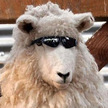
Derek: Weather Sheep
       Every Festival has to have a big STAR, of course, to draw in the punters - and the big celebrity draw at the EeF this year is - ta-da! - Derek the Weather Sheep, fresh from his battle with Facebook, where he spoke up for the freedom and dignity of sheep everywhere.
     Besides Derek, there will be crime writers, sci-fi writers, horror writers, romance writers and writers who are hard to categorise. There will be workshops, discussions, reviews, ideas, recommends, and FREE ebooks. (And the Festival is free, did I mention?)
     There will be music, there will be laughter. The beer, wine and horlicks will flow freely, as will the chocolate (but only if you supply it.)
       Each day will start at 10am, with an overview of all the events for that day. You'll be able to lunch with an author throughout the fortnight; and each day will wind up, at 11pm, with reflections

     You can follow the Festival on Twitter at @edebookfest
     You can find more news on Facebook, here. 

     And you can find the Festival itself HERE.
    Follow the link to find out a lot more about the events on offer, and the writers involved.

     I shall be showing up myself on the 17th and 18th, along with my colleague, Alan Hess, and we'll be demonstrating our interactive reading books.
______________________________________________________

Functional Literacy workshop with Sue Price (and Alan Hess)

Susan Price (2)

This is an ‘offsite’ opportunity for you to find out more about ‘functional literacy’ and how ebooks and the online experience can open new doors for readers.  Authors Electric founder Sue Price guides you through a DIY workshop experience where you can explore the concept of  functional literacy for yourself.
______________________________________________________

          I'll be seeing you at the Festival, I hope?


Saturday, 1 October 2011

EDINBURGH


Edinburgh
          Edinburgh knocks London into a cocked hat.  For that matter, it knocks Birmingham into a cocked hat.  And pretty much any other city in the UK that I’ve ever visited.
          Davy was born in Edinburgh, and I went with him last week, on a visit to his home city.  (We thought about going to Tunisia for a week, but then decided to go to Scotland instead.)
          We drove up, got B&B in a beautiful old town house in Mayfield, and spent the evening walking round the city.  We ate kebabs in Nicholson Square, near the University and then wandered past the magnificent neo-classical College of Surgeons, and little shops selling legal highs and student fashions.
          We climbed up to the Royal Mile and, as always, I was thrilled by those tall, gaunt buildings, so handsome and so Scottish, and the beautiful sweeping curve of the road down into Fleshmarket.
          As dusk fell, and the lights came on, we wandered back down towards Princes’ Street.  Arthur’s Seat looked very volcanic in the background; Scott’s Monument was Gothic and magnificent, and there were the floodlit Scots Baronial piles of the Balmoral and the old Scotsman building on North Bridge.
Nessie in national dress
          There is a buzz about Edinburgh that I don’t feel anywhere else.  I know that there’s plenty that’s grim about the place, both historically and now; but it is such an invigorating mix of broad boulevards and tiny steep closes; of grim ancient towers, grey neo-classical palaces, exuberant Victorian Gothic, and little caffs; of great art and cuddly Loch Ness monsters wearing kilts.  The people range from locals shopping for the kids’ tea, to year-round tourists from every part of the world, to students dressed in the most outré clothing they can devise.  (I offered to buy Davy a neon-tartan kilt and a tam with built-in red wig, so he could rediscover his roots, but he said he didn’t want to.)
The Hind's Daughter - Guthrie
          The next day, at the Scottish National Gallery, we had to descend deep beneath the ground in order to be amazed by the Scots Colourists and the Glasgow Boys.  Why these paintings aren’t in the entrance hall, I’ll never understand.  They are magnificent.
          Even when leaving this wonderful city, to go on to Fife, we had the pleasure of driving over the Forth Road Bridge, and seeing the Rail Bridge beside it.  Oh beautiful railway bridge of the silvery Tay!  I am very happy to say, and to post it here, on-line, that I shall remember this trip for a very long time.

Susan Price's website: www.susanpriceauthor.com
        
And here's Blot - woken up at last...

Saturday, 28 May 2011

Recipe: Clootie or Clowtie?

                My partner is a Scot, born in Edinburgh and raised in Fife, and he sometimes reminisces about the treats of his childhood: black bun, clapshot, tablet and skirlie.
            He was particularly fond of clootie dumpling.  ‘The skin round the outside was the best bit.’
 
            I said I’d make him one for his birthday.  There were recipes for it all over the internet, of course, but most of them seemed to be about how to cook one in a basin, and to get the ‘skin’, it has to be cooked the traditional way, in a cloot.  Or, what I, coming from the Black Country, would call a ‘clowt’.  (One of the many, many things we argue about is whether it’s a clowt or a cloot you shouldn’t cast before May is out – or oot.)
In the end, I got instructions from Davy’s older sister.  And if you, too, have a wish to cook in the old-fashioned – positively medieval – way, here is how to perpetrate a clootie dumpling.
Surround yourself with the following ingredients:

125g  or four and a half ounces of suet

250g  or 9 oz plain flour
125g or four and a half ounces of oatmeal
250g or 9 ozs mixed sultanas and currants
1 tablespoon of golden syrup or treacle
75g or 3 ozs sugar

2 lightly beaten eggs
1 teaspoon of ginger 1 teaspoon of cinnamon
1 teaspoon of baking powder
4 tablespoons of milk
Flour for the cloot (or clowt)

            You can add a tablespoon of any spirit of your choice to it – whisky, brandy, rum – if you wish.
            Rub the suet into the flour as if making pastry – that is, you rub with your fingertips until the mixture looks like breadcrumbs.
            Then add the oatmeal, baking powder, sugar, dried fruit, and the ginger and cinnamon.  Mix it all up well; then add the eggs and syrup.  Mix well again, and add the alcohol, if you’re using it.  Add milk gradually and only until you have a firm mixture.  You want firm, not sloppy, or it’ll be hard to tie up in a cloot.
            Then for the interesting bit.  First scald your chosen cloot (or clowt) in boiling water, and spread it out, steaming, on a work-top.  Sprinkle plentifully with plain flour.  It’s this flour which, when it hits the water in the pan, will instantly form a seal and prevents the water getting in.  It also forms the prized ‘skin’ of the dumpling.
Plain flour spread over a hot wet tea-towel looks a right mess.
            Dump your pudding mixture into the middle of this hot, wet, flour-covered clowt (or cloot), and tie it up loosely with a string.  A pudding-string, in fact.

‘Sing, sing, what shall I sing?
The cat has stolen the pudding string!
Do, do, what shall I do?
The cat has bitten it right in two!’

            You tie the pudding up loosely to allow it a bit of space to expand.
            To cook the thing, take a large pan, and place an upside down saucer at the bottom.  Fill with hot water and bring to the boil.  When the water is roiling away, put in the pudding.  The instant sealing, regrettably, doesn’t announce itself with any kind of hiss or other sign (I was disappointed to discover).  Cover with more water if necessary, and boil it for three blessed hours.
            Keep checking on it, so it doesn’t boil dry, and add more boiling water as necessary.
            Of course, you can be unadventurous, and cook it in a bowl, in which case you’ll need to grease the bowl well, and leave an inch of space at the top for the thing to grow.  Cover it with greaseproof paper and tie firmly with any pudding-string the cat has left unchewed.  You still have to boil it for three hours.
            You can have more fun with a clootie by putting small coins into it, and your guests can try to eat without breaking their teeth or choking.  I see that, on the internet, they suggest first boiling these ‘small coins or charms’ and then wrapping them in waxed paper.  Davy sneers at such namby-pambiness.  Bung them in unwrapped and improve your family’s immune system!
            After three hours, you can fish the thing out, unveil it, and have at it with knives and other weaponry.  I accept no responsibility, should it fight back.
Some authorities say you should dry the skin of damp flour out by baking it for a few minutes  - others regard this idea with horror.  So, take your choice.
            Davy is of the non-drying school, and declared himself well pleased with his birthday Clootie, which we ate with custard – though naturally, cream or ice-cream will do just as well.
            My opinion?  It’s boiled fruit cake: fruity, spicy and sweet.  The especial deliciousness of the skin, I’m afraid, evaded me.  Baking it dry and crisp would surely improve it, but I was forbidden so to do and haven’t tried it since.
            The versatile clootie can also be spread with butter and jam, which I can’t help feeling is over-kill, or with cheese, much as rich fruit cake is eaten with Wensleydale.  Which is delicious, and so clootie and cheese probably is too, though I haven't tried it.
Left-over clootie can be sliced and fried in butter, as it was in Camelot, in the days when King Arthur was a thieving king   – 

‘And on that fruity pudding
All the knights and horses dined,
And what they couldn’t eat that night
The Queen next morning fried.’

            Though whether Guinevere served the fried pudding with bacon and beans, as I’ve seen recommended for clootie dumpling, is not recorded.  I can only imagine that raging indigestion would be the result, but I don’t speak from experience.   Perhaps someone who’s dared will let me know.

         Visit my website at www.susanpriceauthor.com