I first heard of the Scrivener programme when I was working
 for the RLF. Another writer told me about it. The programme was, he said, the greatest example of writerly procrastination ever. Its creator, Keith Blount, allegedly, came up with it to help him organise his material for his 'big novel' - which still hasn't been written.
Later I heard about it from Authors Electric's Chris Longmuir, who is a big fan - and will be writing about it for a forthcoming Authors Electric 'How To Day' on the 29th day of some future month.
My impression, after reading what Chris had to say, was: 'Well, I can do all of that in Word.' If I want all my research for a book in one place, I can make a Research File, and give it sub-headings with Word's 'Document Map' or 'Navigation Pane.' If I want visual references, I can insert them into the files. Another Author Electric, Catherine Czerkawska, was sceptical too. One of the features Chris mentioned was being able to write scenes out of sequence, store them in a separate file, and then, later, slot them in where they seem to fit best. 'I never write out of sequence,' Catherine said, 'so I don't think I'd find this useful.' We're not easy sells, me and Catherine.
But I'm between books at the moment - always a restless time. Sterkarm 3 is still with my new agent. I've finished the book about the boy walking across the Highlands with herd-dogs, and am letting it rest for a while. (A child at a school recently suggested I call it 'Those Two Dogs.')
So I've dug out a couple of projects that fell by the wayside a while ago. One is partly written, but has no middle or end (but a lot of promise, I think.) The other is a pretty wild and woolly, futuristic, SF-flavoured idea which is still in the first sketchy stages of planning. (I abandoned it, not because of lack of enthusiasm, but because Life got in the way about a year ago. Oh, and the Scottish dogs came bounding into view.)
I've been casting round for a way to plan out these books, so I can see clearly what I've got and where they might head. I wanted to use something like the Beat Sheet ideas set out by Roz Morris in 'Nail Your Novel' and also in 'Save The Cat!' by Blake Snyder.
Trouble is, these methods require lots of fiddly index cards, or big sheets of paper, and space to spread them out - space I don't really have. Was there some tighter - almost, you might say, virtual - way of doing it? And I remembered that Scrivener offers a free 30 day trial.
So I went here, and downloaded it.
First of all I read through the substantial - two hours! - introductory course that comes with it. It made my head spin, and I felt a bit overwhelmed - but I have to say it is very thorough. And interactive, so you actually get to try the tools out as it takes you through them. Okay, it takes two hours, but you do finish up with a very good idea of what Scrivener can do - and, I suppose, if you hate it, you can cut your losses right there, uninstall it, and never think about it again.
I liked what I saw, so I decided to go ahead and load my work into it, and see how I got on. And after a night's sleep, I found it much less overwhelming, and quite easy to use.
I've been working with Scrivener for a couple of days now, and I think I may be a convert. Scrivener costs $40, by the way, which works out at about £30 - which, considering everything it does, is pretty good value.
So here's what Scrivener looks like on my screen.

To the left is the pane which holds the 'Binder' for this particular project. Think of it as a giant folder to hold all the other folders.
The staggered entries you can see down this panel are my entered chapters and scenes.
At the bottom of this pane are folders for storing Research, Characters and Places - all accessible by simply moving your cursor to the left.
And you can split the screen, either horizontally or vertically, so you can have your work on one side of the split, and a reference file, maybe a visual reference, on the other. (You can do this in Windows, but it's much easier in Scrivener.)
To the right is another pane, which holds the 'index cards' which will show up on the 'corkboard'. Here you can enter a brief summary of each chapter or scene: who's in it, what happens, where it takes place, etc. At the bottom of this right-hand pane is a section where 'key-words' can be entered. These will help you find a particular spot or - if a key-word is a character's name, for instance - find every chapter and scene in which they appear and 'compile' them, so you can read through only those scenes, and check how they are working.
In the centre is the edit box where you write - or copy in what you've already written. You can work through in order, from beginning to end, or you can write scenes here and there as they occur to you and fit them together later. Scrivener is designed to work with you, whatever your style.
And say, for instance, that you wanted to take an overview of just those scenes featuring your talking dog. Use key-words to find them and 'compile' them in the Edit box - it's as if someone had sorted through your paper manuscript, found just those scenes and put them in front of you.
Suppose, as you read through them, you make the odd change here and there - put in a better phrase, correct some typos, etc. At the end of your reading, these separate scenes return to their proper place in the 'manuscript' - but all the changes you made are retained. It's as if you took those pages out of a paper manuscript, checked through them, altered them, and put them back in their proper order. Only a lot easier to do.
Right at the centre of the Edit screen, at the top, are three buttons. They are Pages, Corkboard and Outline.
+(BUTTON.jpg)
Pages, as you'd expect, shows you the pages you're working on, and you navigate through the different chapters and scenes by clicking on the headings in the pane to the left. This is also where any compilation you choose to make is read.
But sometimes you get befuddled by all those words. You want to see the story simply laid out in front of you. At those times you click on Corkboard, and this shows you your 'index cards' notes from the right-hand pane - but shows you them all together. Like this. (You can change the size of the cards, and how many appear in a row.)
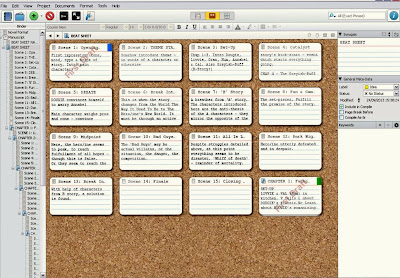
I made my first 'chapter' a list of beats instead, to help me plot my story - each 'scene' or 'index card' is a beat in the story. Tiny pictures can be imported into the top left corner of the card, and differently coloured 'pins' can be added to the right hand corner (say, a different colour per character.) You can move them around, to see if your story can be improved.
But I think I may find the third button as useful, if not more so. This shows you an outline. Like this:

It's the index cards simplified, and gives you another way of keeping track of who's doing what to whom, and when.
I haven't even talked about the research, character and place files, or what Scrivener will do for you when you've finished your book.
I think this blog may run to two or three episodes...
And I have a month to decide whether or not to cough up thirty quid to buy the programme. Scrivener promises that I'll be able to unload all my writing from the programme, without harming it, if I decide not to buy.
But, at the moment, I am inclining towards buying...Or getting someone else to buy it me as a very early Christmas present.

Later I heard about it from Authors Electric's Chris Longmuir, who is a big fan - and will be writing about it for a forthcoming Authors Electric 'How To Day' on the 29th day of some future month.
 |
| ChrisLongmuir |
 |
| Catherine Czerkawska |
But I'm between books at the moment - always a restless time. Sterkarm 3 is still with my new agent. I've finished the book about the boy walking across the Highlands with herd-dogs, and am letting it rest for a while. (A child at a school recently suggested I call it 'Those Two Dogs.')
So I've dug out a couple of projects that fell by the wayside a while ago. One is partly written, but has no middle or end (but a lot of promise, I think.) The other is a pretty wild and woolly, futuristic, SF-flavoured idea which is still in the first sketchy stages of planning. (I abandoned it, not because of lack of enthusiasm, but because Life got in the way about a year ago. Oh, and the Scottish dogs came bounding into view.)
I've been casting round for a way to plan out these books, so I can see clearly what I've got and where they might head. I wanted to use something like the Beat Sheet ideas set out by Roz Morris in 'Nail Your Novel' and also in 'Save The Cat!' by Blake Snyder.
 |
| Roz Morris |
So I went here, and downloaded it.
First of all I read through the substantial - two hours! - introductory course that comes with it. It made my head spin, and I felt a bit overwhelmed - but I have to say it is very thorough. And interactive, so you actually get to try the tools out as it takes you through them. Okay, it takes two hours, but you do finish up with a very good idea of what Scrivener can do - and, I suppose, if you hate it, you can cut your losses right there, uninstall it, and never think about it again.
I liked what I saw, so I decided to go ahead and load my work into it, and see how I got on. And after a night's sleep, I found it much less overwhelming, and quite easy to use.
I've been working with Scrivener for a couple of days now, and I think I may be a convert. Scrivener costs $40, by the way, which works out at about £30 - which, considering everything it does, is pretty good value.
So here's what Scrivener looks like on my screen.

To the left is the pane which holds the 'Binder' for this particular project. Think of it as a giant folder to hold all the other folders.
The staggered entries you can see down this panel are my entered chapters and scenes.
At the bottom of this pane are folders for storing Research, Characters and Places - all accessible by simply moving your cursor to the left.
And you can split the screen, either horizontally or vertically, so you can have your work on one side of the split, and a reference file, maybe a visual reference, on the other. (You can do this in Windows, but it's much easier in Scrivener.)
To the right is another pane, which holds the 'index cards' which will show up on the 'corkboard'. Here you can enter a brief summary of each chapter or scene: who's in it, what happens, where it takes place, etc. At the bottom of this right-hand pane is a section where 'key-words' can be entered. These will help you find a particular spot or - if a key-word is a character's name, for instance - find every chapter and scene in which they appear and 'compile' them, so you can read through only those scenes, and check how they are working.
In the centre is the edit box where you write - or copy in what you've already written. You can work through in order, from beginning to end, or you can write scenes here and there as they occur to you and fit them together later. Scrivener is designed to work with you, whatever your style.
And say, for instance, that you wanted to take an overview of just those scenes featuring your talking dog. Use key-words to find them and 'compile' them in the Edit box - it's as if someone had sorted through your paper manuscript, found just those scenes and put them in front of you.
Suppose, as you read through them, you make the odd change here and there - put in a better phrase, correct some typos, etc. At the end of your reading, these separate scenes return to their proper place in the 'manuscript' - but all the changes you made are retained. It's as if you took those pages out of a paper manuscript, checked through them, altered them, and put them back in their proper order. Only a lot easier to do.
Right at the centre of the Edit screen, at the top, are three buttons. They are Pages, Corkboard and Outline.
+(BUTTON.jpg)
Pages, as you'd expect, shows you the pages you're working on, and you navigate through the different chapters and scenes by clicking on the headings in the pane to the left. This is also where any compilation you choose to make is read.
But sometimes you get befuddled by all those words. You want to see the story simply laid out in front of you. At those times you click on Corkboard, and this shows you your 'index cards' notes from the right-hand pane - but shows you them all together. Like this. (You can change the size of the cards, and how many appear in a row.)
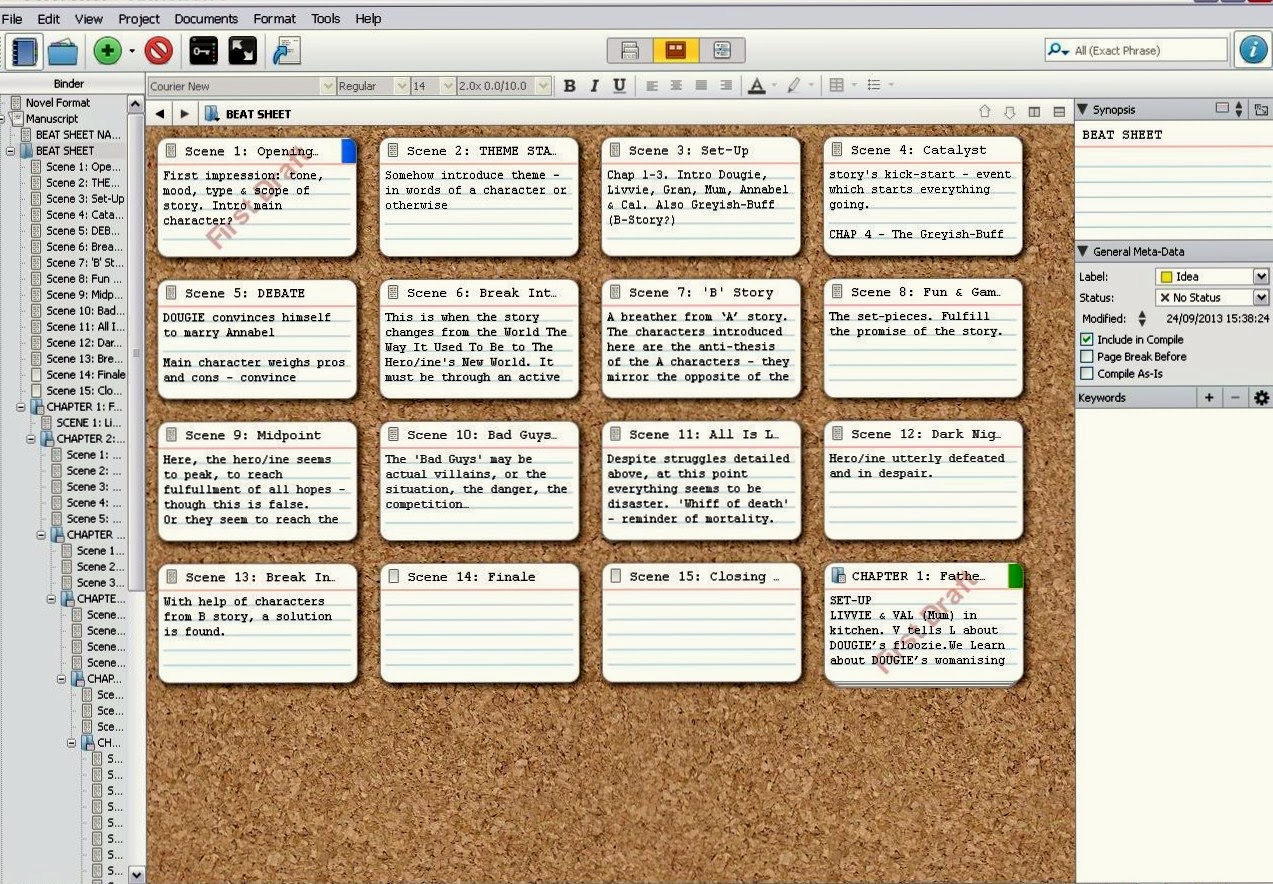
I made my first 'chapter' a list of beats instead, to help me plot my story - each 'scene' or 'index card' is a beat in the story. Tiny pictures can be imported into the top left corner of the card, and differently coloured 'pins' can be added to the right hand corner (say, a different colour per character.) You can move them around, to see if your story can be improved.
But I think I may find the third button as useful, if not more so. This shows you an outline. Like this:

It's the index cards simplified, and gives you another way of keeping track of who's doing what to whom, and when.
I haven't even talked about the research, character and place files, or what Scrivener will do for you when you've finished your book.
I think this blog may run to two or three episodes...
And I have a month to decide whether or not to cough up thirty quid to buy the programme. Scrivener promises that I'll be able to unload all my writing from the programme, without harming it, if I decide not to buy.
But, at the moment, I am inclining towards buying...Or getting someone else to buy it me as a very early Christmas present.


.jpg)
.jpg)
.jpg)
.jpg)


.jpg)
.jpg)
.jpg)
.jpg)

.jpg)


.jpg)
.jpg)
.jpg)


