Showing posts with label self-publishing. Show all posts

Friday, 17 February 2017

Hailing Far Spring...

Valentine's Day is when the birds do choose their make.

Right enough, action in the garden is hotting up. 

Here's my garden, in a picture taken last year.


It is so bleak and grey and cold out there at the moment - except for one bright clump of primroses at the end of the pond which have never stopped flowering. But shoots are coming up everywhere: all over the garden and in pots. I can't tell you how much I'm looking forward to them flowering.

The pond we dug out last January has been wonderfully successful in increasing the number of visiting birds. Before we had zero. Now they come winging in every single day. We have our own little colony of sparrows and before, I never appreciated how acrobatic they are. They hover at the feeders while trying to find a place. They chase each other round them. Today I saw a couple doing loop-the-loops around each other in mid-air. They reguarly come down in a mob to drink at the pool's edge and bathe, even on the coldest day.

We've got used to the fact that the birds resent our presence in the garden. If we linger over tasks, they crowd the trees and yell at us. If we persist, they drop down to slightly nearer branches and yell louder. I've come to recognise the peculiar whistling whoop that starlings make and the craak-craak-craak of magpies. The moment we step back inside the house, they come down to the pond and feeders in flocks before we can pull the door shut.

The magpies swagger about, wearing their gangster black-and-white. Until I saw them close up and so often, I never realised what an iridescent shimmer of petrol blue runs over their black feathers.

The starlings come in gangs of five and seven, with wicked beaks like stilettos, and frantically fight to get into small hanging bird tables and squabble with the sparrows over the spaces on the feeders. Or they plummet down and raid the ground-feeder.

There is a tiny wren that we see more and more often as Spring approaches. It drank from the pond today, a tiny little ball on the edge of a slate. It searched the rose bush above the pond and walks
Wren:  Dibyendu Ash, wikimedia
vertically up walls, investigating the slight crevices between bricks. A couple of days ago it was right by the patio doors, pecking away at something invisible and taking no notice of us. Update: I was turning the compost heap yesterday and a bird above me in the tree was calling out repeatedly in a very loud but melodious voice. Thinking it might be the blackbird, I looked up - and it was the wren. I could see it clearly silhouetted against the sky: a tiny round ball with its tail stuck up at right angles. Its voice is about five times bigger than it is.

Woodpigeons, robins, blackbirds, bluetits and dunnocks visit us reguarly. The bluetit, yesterday, perched on the very highest twig of the leafless lilac and turned this way and that, stretching up onto tip-toe, as he shouted and yelled. Another bluetit came to a lower branch and appeared to listen. They whizz back and forth to the feeders like tiny, bright bits of animated enamel.

And this character (below) has dropped in every day for a week. He has a long spring-loaded tail which you can't see in this photo but which constantly twitches up and down as he hops and pecks about the pond and investigates the ground-feeder.

Grey Wagtail: Wikimedia: Glyn Baker
 Thrilled with so much success, I have plans for next year. I've invested in a silver birch and a holly for my 'wood.' And I'm creating a mini-orchard where my shed used to be. I have a cherry, a bardsey apple and a plum tree, all grown in pots. They have leaf-buds and seem to be doing well. I'm keenly looking forward to seeing how they do.

They will add more leafage, more pollen-producing flowers (never mind the hay-fever) more bark - and therefore more insects. Which in turn will mean more birds and animals that eat insects. I would like to see frogs in my pond. And a newt. I would really love to have a newt.

I planted a St. Swithin rose today, to climb over a fence, both to hide the rather ugly fence and to provide more hiding/living space for birds and insects. I'd like to have a hazel tree in a pot because I love hazelnuts. And strawberries and bilberries. Perhaps a tiny wild flower meadow in a raised bed.
We shall see how much of this comes to - er - fruition.

Sunday, 25 December 2016

Ghosts of Christmas Past

My mother loved Christmas.


You know who he is - illustrated by T Nast (Public Domain Review)

     She was born in 1929, the youngest of six children. Every year, at Christmas, she told us about Christmas when she'd been a child.
     The Christmas, for instance when, coming down in the morning, she found a monkey in the kitchen. One of her three older brothers had somehow acquired it at the Christmas Wake (a fair.) Christmas spirit had probably been strong in the brother, if not the monkey. What happened to the monkey? As with many of my mother's stories, I don't know. I can't remember her ever telling me that. Perhaps she didn't know herself. I can't imagine the monkey remaining a member of the household for very long after my grandmother arrived home.

Every Christmas without fail, we heard about the big white enamelled bucket. It had a lid. It was a lidded big white enamel bucket.
     For most of the year the big white enamelled bucket with a lid was for fetching water from the pump in the yard and storing it in the house. But at Christmas, it was used for storing nuts instead. What was done with the water over Christmas? Were people pushed out into the freezing slippery yard with jugs and basins? Again, I was never told. But at Christmas, for sure, that big white enamelled bucket with the lid was filled to overflowing with monkey-nuts, walnuts, cobnuts and brazils, all of them still in their shells. The nutcrackers lay on the top, nestling into the nuts, ready for use. I think it was the great quantity of that luxury, nuts, that had impressed my mother.

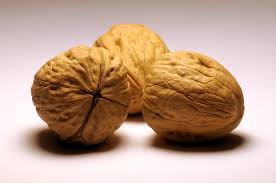
Walnuts were, by the way, fun for all the family.  Carefully shell two walnuts so you have four perfect half-shells. Scrape them out and make them smooth. Scoop up a passing cat. (There were always a few cats about in my mother's house. There was one which my mother strongly resented because it could open the back door when she was still too short to reach the latch. On returning from school to an empty house, she used to have to wait in the yard until the cat chose to saunter home and let her in. Despite this, she was a great cat-lover in later life.)
     Anyroad, the cat and the walnut shells. Fit a half-shell onto each of its paws, then put the cat down on the bare stone flags or tiles. There were no carpets in my mother's home. The cat finds itself tap-dancing. Never having heard a sound from its own feet before, it attempts to escape the clatter, only to tap louder. The more frantically the cat tries to escape the noise, the louder the clatter of walnut shells on stone becomes.
     This was more fun for my mother's brothers, admittedly, than for the cat. But they had to make their own entertainment in those days.
     Another use for walnut shells. Mum taught us how to make little boats out of the half-shells. Fitted with matchstick masts and paper sails, they formed a flotilla in a bowl of water.
     And corks. Most bottles in her childhood had real corks, and more corks were pulled at Christmas than at any other time. These were turned into horses, to stand about on the bowl's shore, admiring the boats. The horses' legs were matchsticks, and a head and neck were cut out of card. A slit in the end of the cork allowed the cardboard head to be slotted into place. Tails and manes could be made from bits of old wool. You could blacken the end of the matchsticks to make hooves and draw in eyes and mouths. You could even make them saddles and reins.
Walnuts, wikimedia

My mother, as the youngest of six, considered herself spoiled but Christmas in the 1930s was still for most people, as it had been for centuries, a brief time of treats in a year of penny-pinching and making-do. Another of my mother's memories was of how an apple was a thing to be cherished and hoarded for days. She polished it on her sleeve, sniffed it, imagined how it would taste. She showed it off and would have all the other children in the street following her about and trying to become her bestest friend, in the hope that, when she finally ate the apple, they might be allowed to have the core.

      At Christmas she looked forward to having a rare tangerine in the toe of her stocking - and this was one of her old socks, not a novelty gift-bag. The stocking would hold a sugar mouse too, and some nuts and raisins.
tangerine: Wikimedia
     My grandmother spread the cost of Christmas over many weeks. After all, she had six sugar mice and six tangerines to buy. She bought white mice for the boys and pink ones for the girls from their corner shop (which was a house with its front room turned into a shop.)
     My mother told me of the ingenious way that my grandmother and other women stretched their money. Twenty of them met, every week, in the local pub. The landlady of the pub, who they obviously trusted, acted as treasurer. Each woman put a shilling (5p) into a big jar. For the first week, nothing was paid out, but a time-table was drawn up for twenty weeks ahead. Each woman drew one of these weeks out of a hat.
     The next week, they again put in a shilling, so the jar held 40 shillings or two pounds. The woman who had drawn the first week was given twenty shillings, or one pound, from the jar.
     The next week, they all put in another shilling and the woman who'd drawn the second week was given a pound - and so on. This 'Inflation Calculator' reckons that £1 in 1935 would have been worth about £50 today, whereas the shilling each woman put in was worth about £2-50.
     This ingenious system allowed the women to budget ahead. This week and next week, they were hard-up - ah, but the week after that they would have a whole pound to play with. They could delay large purchases, like coal, until 'their week.' They also made arrangements between each other. If one woman desperately needed the money that week and another could wait, they swopped weeks. When  it was their week to receive a pound, they often asked to be given only 19/- (the /- meant 'shilling') and so covered their payment into the pool.

But I was telling you about sugar mice. After Christmas, my mother said, she and the brothers nearest her in age hid their stocking and sugar-mouse from the others. The utmost ingenuity and enterprise had to be used because if one of them found the stockings belonging to the others, they would eat sugar-mouse, raisins, nuts and all while hoping that the others hadn't found their special, secret, undetectable hiding-place. The two oldest sisters never bothered to hide their stockings. Since their mother worked, these two acted as mothers to the rest and it was considered bad form to gnaw their mice when they hadn't even hidden them. (The oldest brother's stocking was also safe. He worked in a steel-mill, flinging and catching bolts of white-hot iron with a pair of long tongs. Nobody was going to nick his sugar-mouse.)

My mother was usually given a 'Wonder Book' for Christmas too: a large, hard-backed book, full of stories, puzzles, things to make, and experiments to try. They were often beautifully illustrated. My mother loved and treasured hers but one day, when she was twelve, returned home from school to find that her mother had given all of them away, together with many of her toys because 'she was too old for things like that now.'
     This was one reason why my mother bought us so many books, including second-hand copies of her old wonder-books, and why she would never, never even consider throwing or giving away anything that belonged to us without our permission. I don't think she ever forgave my grandmother for giving away her things. (To speak in my grandmother's defense: She had herself started work at 10, so perhaps 12 did seem 'too old' for toys to her. Also, she never understood why anyone would waste their time reading. She spent Christmas at our house once, in her old age and stared for a long time at the floor-to-ceiling books before shaking her head and saying, "But what use am they?" We were without answer. To us, it was like asking what use the floor or walls were.)

My mother copied her mother in this much: she started buying for Christmas in August. Gifts would be stashed away in the bottom of her wardrobe or on top of it. Bottles of booze and ingredients for baking would be packed onto the back pantry shelf. The chest at the bottom of the hall would be slowly filled with nets of nuts, bags of crisps, packets of biscuits and sweets. She never allowed for the fact that she had only three children (four when my youngest brother arrived) and not six. We would be eating 'Christmas treats' until Easter.
     In the week running up to Christmas, she would organise us as hands for her mincepie factory. She would make the pastry. One of us would grease tins. Another would cut out pastry circles. A third would fill the pies. The one who'd been greasing tins would then go to the other end of the line and stick on lids. Milk and egg was brushed on. Sugar was sprinkled. Mother operated the oven, putting tray after tray in, and bringing out sweet, spicy mincepies in batches of twelve.

Nightcomers by Susan Price
We always had a Christmas tree and Mom would tell us how, when she'd been a child, they had a 'bush' not a tree. This was a construction of coat-hangers or wooden rods, fastened together to make a cross. It was covered with greenery or tinsel and hung from the ceiling. Glass ornaments, holly or mistletoe could be added, according to taste.
     Many of the ornaments we hung on our tree had a long history and stories attached. In the 'trimmings-box' we had some bits of blackened string with odd little wormy bits dangling from them. My mother told us that this had once been tinsel. When new it had been as bright and shiny as the glittering tinsel we enjoyed, but it had tarnished and turned black. We still hung it on our tree, in memory of Christmases past.
     My mother's memories of Christmas and my own inspired my story 'The Christmas Trees' which, if you're still in the mood for Christmas, you can read here.

     It's the gentlest and most nostalgic story in my collection, Nightcomers: Eight Stories of the Uncanny.


Saturday, 7 February 2015

Pubowrimo 3

2, 278 words.
          That's how many I got done in this week's pubowrimo.
          First, I went off to a garden centre, to buy some in-the-green snowdrops. And some winter aconite and a hellebore, because they were there.
          The hellebore is beautiful, and reminds me of my mother. She always called it 'a Christmas rose.'
Christmas Rose

          I love the aconite. It's bright yellow, and smells of honey.
          And of course I love snowdrops. That goes without saying.
Wafts of honey scent...
          I also bought a large - a very large - plastic pot, because I caught Diarmuid Gavin on TV, making a 'container water-garden' to attract insects to the garden by adding another eco-system, in miniature. I loved the idea. And since it seems fairly simple and inexpensive, I'm set on doing it. So I've got the pot. The plants will have to wait until later, I think, until water stops turning to stone in my back-yard. I know the water plants are hardy - even the water-lily, it seems, tough as old boots - but they'll have enough trouble surviving anywhere near me without adding sub-zero temperatures to their lot.
          Anyway, afterwards, I met up with my friend, and we went to the pub, bought cider and settled in - in the corner by the fire this time.
          I had a quite tricky part to write, where a character has been set up by another, so it seems that he's made a serious suicide attempt. This results in him being sectioned under the Mental Health Act and admitted to a secure ward. I had no idea how to tackle this.
          But as soon as I walked through the door of the pub, ideas started to pop. It's all becoming a bit Pavlovian. Pub = write.
          Two thousand, two hundred and seventy-eight words. And I'm getting some ideas for the next part too. The gloves are coming off. The Bad Girl is baring her teeth and becoming frankly murderous - and the object of her homicidal intentions is a character uncomfortably like my beloved auntie. I didn't realise I was basing this character on Beloved Auntie until she was firmly established and it was too late. It's a little inhibiting. Has anyone else found themselves authorially threatening the life of a favourite relative?
          My friend reports that he managed another solid 700 words - and he's pleased because he didn't think he'd be able to write anything this week. He also confesses to two unofficial pubowrimos at home - domestowrimos, I suppose. With tea instead of cider. He's trying to steal a march on me. He did another 700-ish words in each stint.
          Ha! I'm still ahead.
          Not that it's at all competitive, of course.
          The secret, I think, is a free-flowing, scribbly pen that flows easily over the paper, without needing any pressure. The writing is sometimes hard to decipher when you come to type it up, but you can't half cover the pages.


Saturday, 10 January 2015

I Talk to Karen King...

Recently my friend, the writer Karen King, interviewed me for her blog.

Karen King
 
Karen: What was the first thing you had published?

          Sue: The first book I completed: The Devil’s Piper. I wrote it when I was fifteen, typed it on an ancient iron typewriter, and illustrated it myself, in biro pen.(Not a good idea or a success.)

     One of A M Heath’s agents, Osyth Leeston, took me on — and
The Devil's Piper by Susan Price
sent the book to Phyllis Hunt, who was then children’s editor for Faber — and a wonderful editor. Phyllis said she would publish the book if I could rewrite it to the standard she required. She sent me a ten page letter of comments on why the book didn’t work as well as it could, and how it could be improved.


     Looking back at this from over forty years on, I’m incredulous. I don’t think this would happen today. Publishers in those days took more care of their eco-system — they knew they had to be growing authors up to replace those they were going to lose. And, of course, both Osyth and Phyllis were extraordinarily kind and encouraging to me. Phyllis once said that she thought she had ‘brought me up’ as a writer — and I wouldn’t argue with that. 

     I’ve no doubt there are people just as kind in publishing today, but I don’t think they would have the time or the leeway to help a novice along as I was helped. — Or perhaps I’m completely wrong, and just indulging in a senior moment of ‘things were better in those days?’ If so, please let me know. 

Karen: What do you like writing most? 


          Sue: Something that sells millions, gets turned into a film and makes me rich! 

     It’s a question I find hard to answer seriously. One of the comments made early in my career by my fairy godmothers, Phyllis and Osyth, was that I wrote a lot of different things, and was hard to categorise. I’ve written ‘kitchen-sink’, historicals, full-on fantasy, folkloric retellings, science-fiction, short stories, ghost stories… I’ve written for pretty much every age-group too, from babies to adults. As you can see, on my Amazon page.
 
      And the book I’m working on now is different again: set in the present day, with a truly evil, heartless main character who enjoys tormenting other people and looks on murder as business.
I enjoy writing it all. 

Karen: What piece of writing/work are you most proud of? 

          Sue: The Ghost World Trilogy, certainly. The first one, The Ghost Drum, won the Carnegie Medal. That was a surprise — but as soon as I finished the book, I knew it was the best thing I’d ever written.
          I went on thinking that until I turned all three into e-books (since they’d been allowed to go out of print, and no publisher would reprint them.) This meant scanning them into my computer and re-reading and proofing them all over again. While doing this, I came to the conclusion that the second book, Ghost Song, and the third book, Ghost Dance, were both, in their ways, better than the first.
     The books don’t form a classical trilogy, with each book
Ghost Song by Susan Price
following on from the one before. In fact, Ghost Song is a prequel to Ghost Drum, and is, I think, more lyrical. Then Ghost Dance is a stand-alone book, though set in the same world. It’s much more sinister than the first two, and has a more complicated plot.

I’ve written a fourth book in the series, Ghost Spell, which I may bring out as an ebook one day.
     I recently turned the first two, Drum and Song, into paperbacks, available through Amazon. People who’d read the books when young kept asking me where they could buy paper copies. I’m quite proud that this book is now selling to a second, even third generation!

          You can find the e-books here.
           And the paperback editions here.


      But I’m also quite proud of my Sterkarm books — The Sterkarm Handshake, A Sterkarm Kiss and, soon, I hope, A Sterkarm Embrace. They have probably been the most successful of my books. Recently, I was in a school giving a talk in the library. The talk ended, the class left — but their young teacher doubled back, stuck her head round the door and said, ‘I didn’t realise it was you, but I just want to tell you that when I was 13, Sterkarm Handshake was my favourite book.’
The Sterkarm Handshake by Susan Price
     Maybe this is why:— Mary Hoffman, the Book Maven, awarded my Sterkarm hero the Number 2 spot in her ‘Ten Hottest Teen Heroes.’ 
     Per Sterkarm in The Sterkarm Handshake by Susan Price. It’s pronounced “stark-arm” and is the name of a family of 16th century border bandits. Per is the only and most beloved son, whose pretty face gets him the nickname of “the May” or maid. But he’s a useful man in a battle, a lusty lover and one who inspires devotion in everyone from his father, to his hounds, to the 21st century time-traveller Andrea. 

         The books are a mixture of science-fiction and history, with the 16th Century Sterkarms clashing violently with the 21st Century time-travelling ‘Elves.’
          The Sterkarms are on their third film option at the moment, and I’m just hoping they’ll gallop home with it this time. I’m also hoping that soon I’ll be able to tell people that the first two have been republished, along with the third.

Karen: What’s your favourite poem? 

          Sue: That’s a tough one. Robert Graves said that you know poetry when you read it because it makes your hair stand on end – and the first time I read Shelley's Ozymandias, I certainly felt my hair rise. I love Marvell’s To His Coy Mistress too — possibly the greatest knicker-dropper of all time!
     Despite being an atheist, I love U A Fanthorpe’s religious poems, particularly Joseph. And I’ve loved the old Border Ballads since I was a teenager — all human passion and crime is there: every kind of ‘cide — patri, matri, infanti, fratri. Some wonderful phrases too, as when Edward’s mother asks him what — since he’s determined to ‘set his foot in a bottomless boat’ — does he leave to her? He answers: The World’s room/ To beg your bread/ For all the lies you told to me.’ 

Karen: What do you like to do to relax? 

          Sue: Read! — And watch telly. And walk over the hills. I like shooting with my longbow — though only at targets! My partner and I love island-hopping by Cally-Mac ferries. Earlier this year we got up at 3am and drove madly north for 8 hours to catch the noon CallyMac from Oban to Barra in the Outer Hebrides. We’re planning to go to Barra again, but this time make our way up the Hebrides, via ferry and causeway. My partner’s an ex-Met-Office weather observer, and very good at avoiding the worst weather. 

Karen: That must come in handy! - What do you like to read? 


          Sue: All sorts. I loved the Game of Thrones series. I only meant to pass the time by looking into the Amazon sample of A Song Of Ice and Fire, but was hooked and read all seven without a break. Then watched the TV version (very good, but the books were better.)
I love Minette Walters and Sarah Waters. I love legends and mythology. I was stunned by Mantel’s books about Cromwell – so good - and I read and re-read Terry Pratchett all the time. 

          Thanks for talking, Karen!
           Karen's website and blog, where she talks to many other writers, can be found here.
          You can read about her activities as Patron of Reading to Edward Oldcorn College in Worcester, all about her books. She offers teaching in Creative Writing too.

Saturday, 24 March 2012

The End of the Sterkarms


     I’ve worked hard on Sterkarm 3 for three years and until a couple of days ago, never knew how it would end.
     I had a vague idea, a mood – but nothing more.
     I’ve asked myself many times: How do I want it to end?  And also, How do my readers want it to end?
     This hasn’t been a lot of help.  For myself, I drew a blank.  I didn’t know.  I wanted it to end right – that’s all I could say.  And, of course, that’s subjective. What I feel is the right ending, someone else will think wrong.
     Much as I appreciate my readers – and I do – I suspected that many of them wanted S3 to end with a big wedding for Per and Andrea and ‘happy ever after’.  And all their dogs and horses happy ever after too.  And it’s not that I’m against this, so much as it never felt right. The Sterkarms’ world was violent and unsympathetic. They wouldn’t know what to do with happy ever after.
     Wouldn’t it be easer to just give my readers what they want anyway?
     No! Because if I didn’t feel it was right, I couldn’t write it.  Its lack of rightness would nag at me with every word.  It would be like trying to swim the Channel in a meringue wedding-dress (and I’m not a good swimmer anyway.)
     But where could I find the right ending?  Will those shops that stock ideas sell it?  Will they deliver?
     I considered story arc. I looked at twists and turns – I think ‘reversals’ is the fancy term.  I constructed coloured diagrams and looked hard at them, noting how the colours parted and joined.  I consulted the runes.
     It did help. I mentioned the difficulties with the time-line last week.  Although I’d been aware that the time sequence of the book was perhaps, well – a bit approximate – it was the mapping that made it apparent how and where.
     None of this helped capture an ending. 
     So I was watching stupid-telly the other night when my hand reached for a note-book and my favourite fast, scribbly pen.  (A pentel energel, recommended by Davy, which floats over the paper and gets thoughts down almost as fast as you can think them.)  The daemon had tapped my shoulder and I started writing almost without stopping to think.
     I scribbled down what I thought the first book in the series, The Sterkarm Handshake, was about.  Not what happens in it, which is mere plot, but what it was about.
     I think it’s about treachery and betrayal.  The Sterkarm badge, the Handshake, is an emblem of their treachery – but they are treacherous because they see themselves as alone in a hostile world.
     The Company makes what seems an honest deal with the Sterkarms, but knows it is selling them short – indeed, as a capitalist business, it must, to make a profit.
     Joe, the 21st Century homeless man, has been betrayed by his society – but finds a home with the treacherous Sterkarms, who see him as one of their own, and, like the Devil, they look after their own.
     And A Sterkarm Kiss? – Treachery and betrayal again.  Andrea thinks she will be returning to her love affair with Per, but finds herself betrayed both by the Company and her own fantasies – and, in leaving the 21st for ever, betrays the loving partner she leaves behind.
     The Company broker an alliance and a marriage between the feudal enemies, the Sterkarms and Grannams – but it is all a huge, deliberate deceit which leads to murder.  (Pure fantasy, of course: this kind of political manipulation never happens in the real world outside of conspiracy theory.)
     Marriage, murder, deceit, treachery - as I scribbled, the ending of Sterkarm 3 leaped into my head.  Calloo!  Callay!  Glasses of   Festival Ale all round!  Boil a haggis!
     Of course, I’m not going to tell you the ending; but I will give you this assurance – No dogs or horses were harmed in the concluding of this novel.

You wouldn't lose your place on a Kindle, Blott!