My mother loved Christmas.
 |
| You know who he is - illustrated by T Nast (Public Domain Review) |
She was born in 1929, the youngest of six children. Every year, at Christmas, she told us about Christmas when she'd been a child.
The Christmas, for instance when, coming down in the morning, she found a monkey in the kitchen. One of her three older brothers had somehow acquired it at the Christmas Wake (a fair.) Christmas spirit had probably been strong in the brother, if not the monkey. What happened to the monkey? As with many of my mother's stories, I don't know. I can't remember her ever telling me that. Perhaps she didn't know herself. I can't imagine the monkey remaining a member of the household for very long after my grandmother arrived home.
Every Christmas without fail, we heard about the big white enamelled bucket. It had a lid. It was a lidded big white enamel bucket.
For most of the year the big white enamelled bucket with a lid was for fetching water from the pump in the yard and storing it in the house. But at Christmas, it was used for storing nuts instead. What was done with the water over Christmas? Were people pushed out into the freezing slippery yard with jugs and basins? Again, I was never told. But at Christmas, for sure, that big white enamelled bucket with the lid was filled to overflowing with monkey-nuts, walnuts, cobnuts and brazils, all of them still in their shells. The nutcrackers lay on the top, nestling into the nuts, ready for use. I think it was the great quantity of that luxury, nuts, that had impressed my mother.
Walnuts were, by the way, fun for all the family. Carefully shell two walnuts so you have four perfect half-shells. Scrape them out and make them smooth. Scoop up a passing cat. (There were always a few cats about in my mother's house. There was one which my mother strongly resented because it could open the back door when she was still too short to reach the latch. On returning from school to an empty house, she used to have to wait in the yard until the cat chose to saunter home and let her in. Despite this, she was a great cat-lover in later life.)
Anyroad, the cat and the walnut shells. Fit a half-shell onto each of its paws, then put the cat down on the bare stone flags or tiles. There were no carpets in my mother's home. The cat finds itself tap-dancing. Never having heard a sound from its own feet before, it attempts to escape the clatter, only to tap louder. The more frantically the cat tries to escape the noise, the louder the clatter of walnut shells on stone becomes.
This was more fun for my mother's brothers, admittedly, than for the cat. But they had to make their own entertainment in those days.
Another use for walnut shells. Mum taught us how to make little boats out of the half-shells. Fitted with matchstick masts and paper sails, they formed a flotilla in a bowl of water.
And corks. Most bottles in her childhood had real corks, and more corks were pulled at Christmas than at any other time. These were turned into horses, to stand about on the bowl's shore, admiring the boats. The horses' legs were matchsticks, and a head and neck were cut out of card. A slit in the end of the cork allowed the cardboard head to be slotted into place. Tails and manes could be made from bits of old wool. You could blacken the end of the matchsticks to make hooves and draw in eyes and mouths. You could even make them saddles and reins.
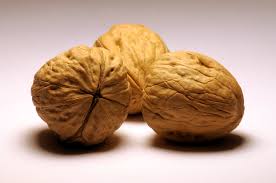 | |
| Walnuts, wikimedia |
My mother, as the youngest of six, considered herself spoiled but Christmas in the 1930s was still for most people, as it had been for centuries, a brief time of treats in a year of penny-pinching and making-do. Another of my mother's memories was of how an apple was a thing to be cherished and hoarded for days. She polished it on her sleeve, sniffed it, imagined how it would taste. She showed it off and would have all the other children in the street following her about and trying to become her bestest friend, in the hope that, when she finally ate the apple, they might be allowed to have the core.
At Christmas she looked forward to having a rare tangerine in the toe of her stocking - and this was one of her old socks, not a novelty gift-bag. The stocking would hold a sugar mouse too, and some nuts and raisins.
 |
| tangerine: Wikimedia |
My mother told me of the ingenious way that my grandmother and other women stretched their money. Twenty of them met, every week, in the local pub. The landlady of the pub, who they obviously trusted, acted as treasurer. Each woman put a shilling (5p) into a big jar. For the first week, nothing was paid out, but a time-table was drawn up for twenty weeks ahead. Each woman drew one of these weeks out of a hat.
The next week, they again put in a shilling, so the jar held 40 shillings or two pounds. The woman who had drawn the first week was given twenty shillings, or one pound, from the jar.
The next week, they all put in another shilling and the woman who'd drawn the second week was given a pound - and so on. This 'Inflation Calculator' reckons that £1 in 1935 would have been worth about £50 today, whereas the shilling each woman put in was worth about £2-50.
This ingenious system allowed the women to budget ahead. This week and next week, they were hard-up - ah, but the week after that they would have a whole pound to play with. They could delay large purchases, like coal, until 'their week.' They also made arrangements between each other. If one woman desperately needed the money that week and another could wait, they swopped weeks. When it was their week to receive a pound, they often asked to be given only 19/- (the /- meant 'shilling') and so covered their payment into the pool.
But I was telling you about sugar mice. After Christmas, my mother said, she and the brothers nearest her in age hid their stocking and sugar-mouse from the others. The utmost ingenuity and enterprise had to be used because if one of them found the stockings belonging to the others, they would eat sugar-mouse, raisins, nuts and all while hoping that the others hadn't found their special, secret, undetectable hiding-place. The two oldest sisters never bothered to hide their stockings. Since their mother worked, these two acted as mothers to the rest and it was considered bad form to gnaw their mice when they hadn't even hidden them. (The oldest brother's stocking was also safe. He worked in a steel-mill, flinging and catching bolts of white-hot iron with a pair of long tongs. Nobody was going to nick his sugar-mouse.)
 My
mother was usually given a 'Wonder Book' for Christmas too: a large,
hard-backed book, full of stories, puzzles, things to make, and
experiments to try. They were often beautifully illustrated. My mother
loved and treasured hers but one day, when she was twelve, returned home
from school to find that her mother had given all of them away,
together with many of her toys because 'she was too old for things like
that now.'
This was one reason why my mother bought us so many books, including second-hand copies of her old wonder-books, and why she would never, never even consider throwing or giving away anything that belonged to us without our permission. I don't think she ever forgave my grandmother for giving away her things. (To speak in my grandmother's defense: She had herself started work at 10, so perhaps 12 did seem 'too old' for toys to her. Also, she never understood why anyone would waste their time reading. She spent Christmas at our house once, in her old age and stared for a long time at the floor-to-ceiling books before shaking her head and saying, "But what use am they?" We were without answer. To us, it was like asking what use the floor or walls were.)
My mother copied her mother in this much: she started buying for Christmas in August. Gifts would be stashed away in the bottom of her wardrobe or on top of it. Bottles of booze and ingredients for baking would be packed onto the back pantry shelf. The chest at the bottom of the hall would be slowly filled with nets of nuts, bags of crisps, packets of biscuits and sweets. She never allowed for the fact that she had only three children (four when my youngest brother arrived) and not six. We would be eating 'Christmas treats' until Easter.
In the week running up to Christmas, she would organise us as hands for her mincepie factory. She would make the pastry. One of us would grease tins. Another would cut out pastry circles. A third would fill the pies. The one who'd been greasing tins would then go to the other end of the line and stick on lids. Milk and egg was brushed on. Sugar was sprinkled. Mother operated the oven, putting tray after tray in, and bringing out sweet, spicy mincepies in batches of twelve.
 |
| Nightcomers by Susan Price |
Many of the ornaments we hung on our tree had a long history and stories attached. In the 'trimmings-box' we had some bits of blackened string with odd little wormy bits dangling from them. My mother told us that this had once been tinsel. When new it had been as bright and shiny as the glittering tinsel we enjoyed, but it had tarnished and turned black. We still hung it on our tree, in memory of Christmases past.
My mother's memories of Christmas and my own inspired my story 'The Christmas Trees' which, if you're still in the mood for Christmas, you can read here.
It's the gentlest and most nostalgic story in my collection, Nightcomers: Eight Stories of the Uncanny.


