Showing posts with label ghost stories. Show all posts

Saturday, 17 January 2015

Pubawrimo

http://www.amazon.co.uk/Wolfs-Footprint-Susan-Price/dp/0992820405/
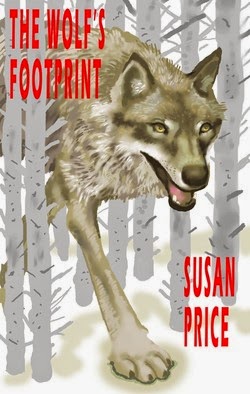
The Wolf's Footprint paperback
Here I am again - and what have I been doing?

Well, I've been at the self-publishing again. Last year I responded to teachers who emailing me, asking for copies of my OOP book, The Wolf's Footprint. So I reprinted it, as an ebook and as a paperback - and found that the paperback sold more than the ebook.

The obvious lesson to be drawn from this seemed to be - self-publish more paperbacks with CreateSpace. So I've now made all of the Ghost World Sequence - The Ghost Drum, Ghost Song and Ghost Dance available in paperback. And they're selling - as with The Wolf's Footprint - better than the ebooks.
The Ghost Drum


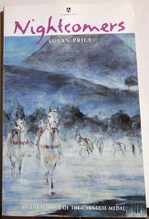
So last week, I worked on Nightcomers, one of my ghost story collections, which contains, I think, some of my best short stories. 'Beautiful' for instance, set in an eerie, after-hours shopping mall, and 'Cold Silver.' I sent it off to Amazon to be approved, and hope that it will soon be available as a paperback.

But I'm also working on a book, as yet unfinished, with the working title of 'Bad Girl.' And she is very, very bad - horrid, indeed - and unlike the girl in the rhyme, she is never really good.

The writing of it was stuck. I knew what had to happen next. The book has multiple view-points, and I knew whose view-point I wanted to take, and I knew more or less what I wanted them to say...But the two or three attempts I made at the chapter were just wrong. It made the points I wanted to make. It covered the ground. It was just flat, dull - wrong.

I tried starting at another point, but it still didn't work. I decided that I needed to jump over some of the dull detail - there was a bit of a list of stuff the character had to get done. Okay, ditch that, get on with the action, and hope the list can be fitted in later... Nah, it still wouldn't work.

As it happens, I have a friend who is also writing a book, and was also stuck. Hadn't written anything for a month. He counted the days. I was feeling pretty thwarted myself, and so suggested we should have a 'pubowrimo.'
http://www.amazon.co.uk/Five-Pound-Pony-other-stories-ebook/dp/B00MC1SHRS/
Karen's lovely book

Most people will have heard of the famous Nanowrimo, or National Novel Writing Month, where writers pledge to write a whole novel in the month of November. And the other day, Karen Bush, on Authors Electric wrote about 'Linowrimo' - about how a group of writers, in touch via email, pledge to write a number of words every day, and report on how they got on.

I'm a member of this group too, and, like Karen, find it a constant source of encouragement and help - but it couldn't  help me sort out the Bad Girl.

Like many other writers, I've often found that, when I can't write at home, I can write pages and pages in a cafe - or on a CallyMac ferry, or on top of a Scottish mountain, in a Loughborough B&B - in fact, anywhere that's not home.

So I suggested to my friend that we take ourselves off to a pub we both like, and see if we could write there. We agreed that we would buy a drink - rent for our office space - but then write for at least an hour before we talked. My friend agreed. He wasn't sure that it would work, but was so keen to get going on his novel again that it was worth trying.

Dear Readers, it worked. I had thought of taking my laptop, but at the last minute decided to take a pile of scrap paper instead, and a favourite scribbly pen (that is, one that floats easily over the paper.) The more complete a change, the better, I thought - pen and paper in the pub instead of a computer at home.

And even while driving there, it started to work. Why, I wondered, did it have to be that POV? Why not try coming at it through another of the characters?
 
A great writing aid.

We reached the pub and found our table. My friend bought a pint of cider for himself and a half for me, and we started. The moment I sat down, the words came. Within a few moments, I'd largely forgotten where I was, or that my friend was with me. The landlady, at one point, came round to ask if anyone had a silver honda in the car-park. I floated up out of a dream, said, "No, not me," and drifted off into writing-world again.

Every now and again, I'd pause to think of a word, or to take a sip of cider and would think - with mild surprise - 'Oh, yes, that's right, I'm in the pub - and oh, yes, that lowered head and scribbling pen over there, that's my friend...' And then I'd lower my own head and start scribbling again.
 
I filled page after page - 2000 words. I'm past the part that held me up for so long. Now I'm up against another problem, with another character - but that's okay. Writing a book is just one problem after another.

And my friend? He was very happy with the experiment too. He wrote 882 words - which, he says, is a lot for him at one time. He, too, feels he's made real progress, and asked, "When shall we do it again?" So the landlady may have to get used to two word-dazed people scribbling at her tables.

Why does it work? For me, I think the change is important, though I don't quite understand why. The change of scene, the change from computer to paper - it all seems to shake up my ideas, to loosen or free something.

My friend says that he knew what he had to write, but was procrastinating, feeling that he wasn't quite ready - that he'd think about it some more before beginning. But the days went by and he never did begin. The special outing, and the solemn vow to write for an hour before talking, made him commit to writing then and there, instead of putting it off. The time set, of an hour, made him keep writing, too, when he would normally have stopped.

So, if the writing's not happening - get out of the house!

Saturday, 7 January 2012

SPEAKING OF SEVERED HEADS...


'Head and Tales' by Susan Price. Rough of cover art Andrew Price
          Introducing my next venture into independent publishing: HEAD AND TALES, one of my collections of retold folk-stories.
           The collection was inspired by a story I found in IRISH FOLK TALES, edited by Henry Glassie, and published by Penguin Folklore Library in 1985.
          I have read and loved folklore since a child, and was well aware that the severed head has a special significance in Celtic-Nordic folklore. Two examples are the severed head of Mimir which, in Norse Myth, is kept beside the spring at the foot of the World Tree, and gives advice to Odin when he needs it; and the head of Bran, from Welsh legend, which continues to entertain and advise his followers after Bran’s death.
          In IRISH FOLK TALES I came across a story, collected in Kerry in 1945, called ‘The Grave of His Fathers.’ It tells of a young man who travels, with a friend, to Northern Ireland to find work. While there he takes sick. He feels that he’s dying, and his dying wish is to have his head cut off and carried home, so it can be buried ‘in my own churchyard.’
          The friend duly returns the severed head to its home village, and the rest of the story tells how, as the funeral procession is approaching the graveyard, they see another procession coming and – as was the custom, the story says – the funeral parties race to see which will have the honour of holding their ceremony first. The other party wins but, as it reaches the graveyard wall, it vanishes.
          The party who’ve come to bury the head are disconcerted, but nevertheless hold their funeral. Some time later another man of the family dies, and they reopen the family grave – but instead of the single coffin they’re expecting, find two. Inside one coffin is a bodiless head; in the other a headless body. So the ‘ghost funeral’ at last makes sense; and the lad who died away from home rests whole and entire in the grave of his fathers.
          I enjoyed the story, but was particularly struck by how, even in 1945, a severed head was given such importance. It is, after all, his head that the man feels must rest in his own country and not, say, his heart.
The well at the world's end - another wise severed head
          I felt that, perhaps, something had been lost from this story – that if it had been told at another time, the head, unable to rest, would have talked to its friend as he carried it home. When I looked up the story for these notes, I found my own pencilled scribble at the bottom of the page: ‘The basis of a story? The head carried from place to place, solving problems, being prophetic?’ (I always make notes to self in the form of questions, to remind me that I don’t have to be restricted by first thoughts.)
          At the same time I’d been reading about the traditions of story-telling, how stories have often been thought of as spells of a kind. The Irish Bards were said to be able to compose such scathing satires that their words raised blisters on the faces of their subjects. Words have power. Stories have power. So some stories were only to be told at weddings, others only at funerals, still others at christenings.
          These ideas underlie several of my collections of retold folk-tales, such as TELLING TALES. They are certainly present in HEAD AND TALES, where, in the framing story, the father’s head, carried by his children, guides, encourages, defends, consoles – and all with stories.
          All the head's stories will, soon, be available as an e-book.

          And, oh, go on - if you liked this even a bit, give us a tweet!

          And now - Blott!


          Hope that's not one of my books...
                   Visit my website at http://www.susanpriceauthor.com/
                        I'm also one of the Electric Authors!

Saturday, 17 December 2011

CHRISTMAS PRESENCE


'Overheard In A Graveyard' by Susan Price.
         
           Christmas will soon be here, and Christmas is the season for ghost stories.  I think it was Jerome K Jerome who observed that at Christmas, that time of fellowship and good cheer, we love to tell stories of the grave, of hearts torn asunder by death, of ghastly presences hovering in the dark just outside the lamplight... How right he was.
          Here's a little Christmas present for my readers, a link to one of the stories in my book OVERHEARD IN A GRAVEYARD - in fact, the title story itself.
          I'll be posting links to another ghost story on Christmas Day itself, over on Do Authors Dream of Electric Books.


'Nightcomers' by Susan Price.
          The story going up on Christmas Day is a much sweeter tale than Overheard - it's based on family Christmases from my childhood, and was inspired by my mother talking about her childhood Christmases and how much her mother always looked forward to Christmas.  It's called 'The Christmas Trees' and comes from my collection of ghost stories, NIGHTCOMERS.
          It's a bit of a family affair, as all the covers to my e-books are done by my brother, Andrew Price.
'Hauntings' by Susan Price
          I have yet another collection of ghost stories on kindle, HAUNTINGS.  I like  ghost stories - I like reading them and writing them.  They aren't an easy form.
          For me, they aren't about gross-out horror.  That's for horror-stories.  Ghost stories, I feel, should unsettle or disturb in some way - but they are as much for talking about sadness and loss as fear.  They are about our shadow-side and the numinous, as well as the dead.
         But for now I'll wish you all a Merry Christmas, because this blog will be taking a break over Christmas (and eating itself sick.)
          But, before I go, Blot has a Christmas Message he wishes to impart - 

Saturday, 15 October 2011

CATS AND GHOSTS


          More ghostly tales then…
          Close the curtains against the dark, and draw your computer chairs closer to the virtual fire...
          Tales of cats this week…
          My aunt (she of the spooky tales) moved back into her parents’ house, to care for them as they died. She brought with her a black cat, named Charny.
          My grandad had always been fond of cats, and Charny soon learned that he was sure of a welcome, and much stroking and ear-rubbing, if he jumped up on the bed in the front room. All the months my grandad lay dying, the cat hardly left the bed. He would jump down to eat or use his tray, perhaps take a quick stroll up and down the garden, and then immediately return to my grandad’s side where he lay, night and day.
          Until two days before grandad’s death, when Charny jumped down, left the room, and wouldn’t go back into it again.  If picked up and carried inside, he struggled, and ran away as soon as put down.
          After grandad died, my aunt had to move, and Charny went with her again – but would not stay in the new house.  He ‘went mad’, running to every door and every window, crying and scratching, not resting until let out into the yard. If carried back inside, he panicked and ran about in fright until the door was opened.
          After a time of sleeping rough, Charney settled happily with a neighbour, and would come back to visit my aunt – but would not set paw in the house.
          I can personally vouch for the fact that almost every cat my aunt has kept in that house developed a habit of freezing and staring fixedly at a spot about half-way up the stairs.  I also heard heavy footsteps climbing the stairs one night when I was house-minding the place.
My parents' wedding
          My mother, too, told a tale of a sensitive cat. When my parents were first married, they lived in the old house where my father had been born.  Mom always disliked it.  It was creepy, she said.
          It was gas-lit, and you had to put money in the meter.  If the gas ran out and you didn’t have any sixpences or shillings, you had to sit in the dark.
          Mom was often alone in the evening, when Dad worked late.  She would sit reading on the sofa, with her cat, Tiny, who lay on her lap for hours, purring.  But when the gas sputtered out, Mom said, and it was  instantly dark, Tiny jumped from her lap and ran under the sideboard, squeezing herself right to the back, cowering against the wall.
          A cat, scared of the dark? You can imagine how my mother felt, as she groped for her purse and scrabbled for a sixpence.  Quite often she didn’t have a sixpence, and had to sit in the dark, wondering what had frightened the cat…
          Other things happened in that house that made her like it even less… but that’s for another blog.
         Have you any good creepy tales of ghost and animals, or ghostly animals?  Or beastly ghosts.  Come on, come to the virtual fire and share them…
          My new ghost story collections, NIGHTCOMERS and HAUNTINGS will be published as e-books, on Hallowe’en.

And here's Blot, with Hallowe'en games...
 
   Bobbing for ideas can certainly be like that....

Saturday, 10 September 2011

GHOSTS AND HAUNTINGS

Hauntings by Susan Price
          One of the jobs keeping me from house-work is turning my two collections of ghost stories, Hauntings and Nightcomers, into e-books.
          This started me thinking about ghost stories and their appeal in general.
          I know I’m not alone in considering M. R. James one of the greatest writers of ghost stories ever.  I remember reading several of his stories, one after another, one dark winter’s afternoon, while alone in the house.  I was in the kitchen, making a snack, when I heard a quiet, stealthy scratching from inside a cupboard…  After I’d dropped down from the light-fitting, I discovered that the noise had been made by a bundle of crumpled plastic bags expanding.  Ever since I’ve thought James’ stories should carry a health warning: ‘One story a day.  Do not exceed dosage.’
M. R. James
          Something I hadn’t appreciated until recently was that James is considered ‘the father of the modern ghost story’ because he did away with Gothic trappings of dungeons and ruins, and set it in what was – for him – the modern world.  He thought this necessary because he wanted his reader to feel : '”If I'm not careful, something of this kind may happen to me!' His modernity is easy to overlook now, because James’ antiquarians in bath-chairs seem so quaint and old-fashioned to us.
         I have nothing against the Gothic, but I largely agree with James on this.  I have set ghost stories in the past – 'Davy', in Hauntings, is one – but most of mine take place in the present, or what was the present when I wrote them.
          The world is a very strange place. The very fact that each of us is alive and self-aware is strange beyond all understanding.  One thing that a story of the supernatural can do is show this ever-present strangeness, to throw a spotlight on the strangeness that exists alongside, or hidden underneath, the everyday.  That’s why ‘Beautiful’, in Nightcomers, is set in a huge shopping mall – I wrote it after hearing my brother, who worked in one, describe what the place was like after-hours, as he made his way through it to the bus-stop.
          It’s why The Landing Window is set on a modern housing estate (even if in an old house); and why Coming Home Late’ is set in a block of council flats.  (And consider that there is more than one meaning to ‘late’.)
          Like James, I want my readers to think this might happen to them!
Nightcomers by Susan Price
          I’m also with James when he says: Reticence may be an elderly doctrine to preach, yet from the artistic point of view, I am sure it is a sound one. Reticence conduces to effect, blatancy ruins it…’  Somewhere he comments that he could  make a reader physically sick, if he chose, but he scorns to do so, because it’s too easy.  It’s far more difficult, he says, to write something that is eerie, unsettling – or haunting, which is why I gave my collection that title.  Don’t come to my stories for all-out, gross-out horror.  No – I don’t want to sicken  you.  I want to get under your skin, to stay with you.
          In short, to haunt you.  It’s for you to say whether I succeed, but that’s my intent.
         Find my e-books for download here.

         And I know you're waiting for Blot -