Showing posts with label Nightcomers. Show all posts

Sunday, 25 December 2016

Ghosts of Christmas Past

My mother loved Christmas.


You know who he is - illustrated by T Nast (Public Domain Review)

     She was born in 1929, the youngest of six children. Every year, at Christmas, she told us about Christmas when she'd been a child.
     The Christmas, for instance when, coming down in the morning, she found a monkey in the kitchen. One of her three older brothers had somehow acquired it at the Christmas Wake (a fair.) Christmas spirit had probably been strong in the brother, if not the monkey. What happened to the monkey? As with many of my mother's stories, I don't know. I can't remember her ever telling me that. Perhaps she didn't know herself. I can't imagine the monkey remaining a member of the household for very long after my grandmother arrived home.

Every Christmas without fail, we heard about the big white enamelled bucket. It had a lid. It was a lidded big white enamel bucket.
     For most of the year the big white enamelled bucket with a lid was for fetching water from the pump in the yard and storing it in the house. But at Christmas, it was used for storing nuts instead. What was done with the water over Christmas? Were people pushed out into the freezing slippery yard with jugs and basins? Again, I was never told. But at Christmas, for sure, that big white enamelled bucket with the lid was filled to overflowing with monkey-nuts, walnuts, cobnuts and brazils, all of them still in their shells. The nutcrackers lay on the top, nestling into the nuts, ready for use. I think it was the great quantity of that luxury, nuts, that had impressed my mother.

Walnuts were, by the way, fun for all the family.  Carefully shell two walnuts so you have four perfect half-shells. Scrape them out and make them smooth. Scoop up a passing cat. (There were always a few cats about in my mother's house. There was one which my mother strongly resented because it could open the back door when she was still too short to reach the latch. On returning from school to an empty house, she used to have to wait in the yard until the cat chose to saunter home and let her in. Despite this, she was a great cat-lover in later life.)
     Anyroad, the cat and the walnut shells. Fit a half-shell onto each of its paws, then put the cat down on the bare stone flags or tiles. There were no carpets in my mother's home. The cat finds itself tap-dancing. Never having heard a sound from its own feet before, it attempts to escape the clatter, only to tap louder. The more frantically the cat tries to escape the noise, the louder the clatter of walnut shells on stone becomes.
     This was more fun for my mother's brothers, admittedly, than for the cat. But they had to make their own entertainment in those days.
     Another use for walnut shells. Mum taught us how to make little boats out of the half-shells. Fitted with matchstick masts and paper sails, they formed a flotilla in a bowl of water.
     And corks. Most bottles in her childhood had real corks, and more corks were pulled at Christmas than at any other time. These were turned into horses, to stand about on the bowl's shore, admiring the boats. The horses' legs were matchsticks, and a head and neck were cut out of card. A slit in the end of the cork allowed the cardboard head to be slotted into place. Tails and manes could be made from bits of old wool. You could blacken the end of the matchsticks to make hooves and draw in eyes and mouths. You could even make them saddles and reins.
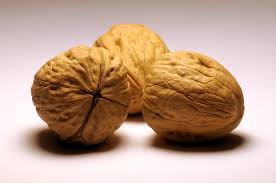
Walnuts, wikimedia

My mother, as the youngest of six, considered herself spoiled but Christmas in the 1930s was still for most people, as it had been for centuries, a brief time of treats in a year of penny-pinching and making-do. Another of my mother's memories was of how an apple was a thing to be cherished and hoarded for days. She polished it on her sleeve, sniffed it, imagined how it would taste. She showed it off and would have all the other children in the street following her about and trying to become her bestest friend, in the hope that, when she finally ate the apple, they might be allowed to have the core.

      At Christmas she looked forward to having a rare tangerine in the toe of her stocking - and this was one of her old socks, not a novelty gift-bag. The stocking would hold a sugar mouse too, and some nuts and raisins.
tangerine: Wikimedia
     My grandmother spread the cost of Christmas over many weeks. After all, she had six sugar mice and six tangerines to buy. She bought white mice for the boys and pink ones for the girls from their corner shop (which was a house with its front room turned into a shop.)
     My mother told me of the ingenious way that my grandmother and other women stretched their money. Twenty of them met, every week, in the local pub. The landlady of the pub, who they obviously trusted, acted as treasurer. Each woman put a shilling (5p) into a big jar. For the first week, nothing was paid out, but a time-table was drawn up for twenty weeks ahead. Each woman drew one of these weeks out of a hat.
     The next week, they again put in a shilling, so the jar held 40 shillings or two pounds. The woman who had drawn the first week was given twenty shillings, or one pound, from the jar.
     The next week, they all put in another shilling and the woman who'd drawn the second week was given a pound - and so on. This 'Inflation Calculator' reckons that £1 in 1935 would have been worth about £50 today, whereas the shilling each woman put in was worth about £2-50.
     This ingenious system allowed the women to budget ahead. This week and next week, they were hard-up - ah, but the week after that they would have a whole pound to play with. They could delay large purchases, like coal, until 'their week.' They also made arrangements between each other. If one woman desperately needed the money that week and another could wait, they swopped weeks. When  it was their week to receive a pound, they often asked to be given only 19/- (the /- meant 'shilling') and so covered their payment into the pool.

But I was telling you about sugar mice. After Christmas, my mother said, she and the brothers nearest her in age hid their stocking and sugar-mouse from the others. The utmost ingenuity and enterprise had to be used because if one of them found the stockings belonging to the others, they would eat sugar-mouse, raisins, nuts and all while hoping that the others hadn't found their special, secret, undetectable hiding-place. The two oldest sisters never bothered to hide their stockings. Since their mother worked, these two acted as mothers to the rest and it was considered bad form to gnaw their mice when they hadn't even hidden them. (The oldest brother's stocking was also safe. He worked in a steel-mill, flinging and catching bolts of white-hot iron with a pair of long tongs. Nobody was going to nick his sugar-mouse.)

My mother was usually given a 'Wonder Book' for Christmas too: a large, hard-backed book, full of stories, puzzles, things to make, and experiments to try. They were often beautifully illustrated. My mother loved and treasured hers but one day, when she was twelve, returned home from school to find that her mother had given all of them away, together with many of her toys because 'she was too old for things like that now.'
     This was one reason why my mother bought us so many books, including second-hand copies of her old wonder-books, and why she would never, never even consider throwing or giving away anything that belonged to us without our permission. I don't think she ever forgave my grandmother for giving away her things. (To speak in my grandmother's defense: She had herself started work at 10, so perhaps 12 did seem 'too old' for toys to her. Also, she never understood why anyone would waste their time reading. She spent Christmas at our house once, in her old age and stared for a long time at the floor-to-ceiling books before shaking her head and saying, "But what use am they?" We were without answer. To us, it was like asking what use the floor or walls were.)

My mother copied her mother in this much: she started buying for Christmas in August. Gifts would be stashed away in the bottom of her wardrobe or on top of it. Bottles of booze and ingredients for baking would be packed onto the back pantry shelf. The chest at the bottom of the hall would be slowly filled with nets of nuts, bags of crisps, packets of biscuits and sweets. She never allowed for the fact that she had only three children (four when my youngest brother arrived) and not six. We would be eating 'Christmas treats' until Easter.
     In the week running up to Christmas, she would organise us as hands for her mincepie factory. She would make the pastry. One of us would grease tins. Another would cut out pastry circles. A third would fill the pies. The one who'd been greasing tins would then go to the other end of the line and stick on lids. Milk and egg was brushed on. Sugar was sprinkled. Mother operated the oven, putting tray after tray in, and bringing out sweet, spicy mincepies in batches of twelve.

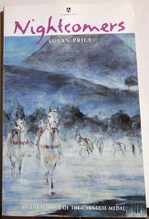
Nightcomers by Susan Price
We always had a Christmas tree and Mom would tell us how, when she'd been a child, they had a 'bush' not a tree. This was a construction of coat-hangers or wooden rods, fastened together to make a cross. It was covered with greenery or tinsel and hung from the ceiling. Glass ornaments, holly or mistletoe could be added, according to taste.
     Many of the ornaments we hung on our tree had a long history and stories attached. In the 'trimmings-box' we had some bits of blackened string with odd little wormy bits dangling from them. My mother told us that this had once been tinsel. When new it had been as bright and shiny as the glittering tinsel we enjoyed, but it had tarnished and turned black. We still hung it on our tree, in memory of Christmases past.
     My mother's memories of Christmas and my own inspired my story 'The Christmas Trees' which, if you're still in the mood for Christmas, you can read here.

     It's the gentlest and most nostalgic story in my collection, Nightcomers: Eight Stories of the Uncanny.


Saturday, 17 January 2015

Pubawrimo

http://www.amazon.co.uk/Wolfs-Footprint-Susan-Price/dp/0992820405/
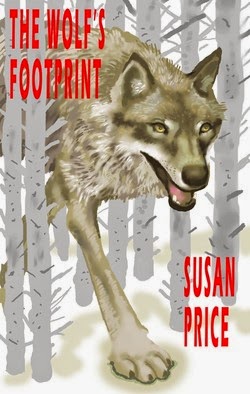
The Wolf's Footprint paperback
Here I am again - and what have I been doing?

Well, I've been at the self-publishing again. Last year I responded to teachers who emailing me, asking for copies of my OOP book, The Wolf's Footprint. So I reprinted it, as an ebook and as a paperback - and found that the paperback sold more than the ebook.

The obvious lesson to be drawn from this seemed to be - self-publish more paperbacks with CreateSpace. So I've now made all of the Ghost World Sequence - The Ghost Drum, Ghost Song and Ghost Dance available in paperback. And they're selling - as with The Wolf's Footprint - better than the ebooks.
The Ghost Drum


So last week, I worked on Nightcomers, one of my ghost story collections, which contains, I think, some of my best short stories. 'Beautiful' for instance, set in an eerie, after-hours shopping mall, and 'Cold Silver.' I sent it off to Amazon to be approved, and hope that it will soon be available as a paperback.

But I'm also working on a book, as yet unfinished, with the working title of 'Bad Girl.' And she is very, very bad - horrid, indeed - and unlike the girl in the rhyme, she is never really good.

The writing of it was stuck. I knew what had to happen next. The book has multiple view-points, and I knew whose view-point I wanted to take, and I knew more or less what I wanted them to say...But the two or three attempts I made at the chapter were just wrong. It made the points I wanted to make. It covered the ground. It was just flat, dull - wrong.

I tried starting at another point, but it still didn't work. I decided that I needed to jump over some of the dull detail - there was a bit of a list of stuff the character had to get done. Okay, ditch that, get on with the action, and hope the list can be fitted in later... Nah, it still wouldn't work.

As it happens, I have a friend who is also writing a book, and was also stuck. Hadn't written anything for a month. He counted the days. I was feeling pretty thwarted myself, and so suggested we should have a 'pubowrimo.'
http://www.amazon.co.uk/Five-Pound-Pony-other-stories-ebook/dp/B00MC1SHRS/
Karen's lovely book

Most people will have heard of the famous Nanowrimo, or National Novel Writing Month, where writers pledge to write a whole novel in the month of November. And the other day, Karen Bush, on Authors Electric wrote about 'Linowrimo' - about how a group of writers, in touch via email, pledge to write a number of words every day, and report on how they got on.

I'm a member of this group too, and, like Karen, find it a constant source of encouragement and help - but it couldn't  help me sort out the Bad Girl.

Like many other writers, I've often found that, when I can't write at home, I can write pages and pages in a cafe - or on a CallyMac ferry, or on top of a Scottish mountain, in a Loughborough B&B - in fact, anywhere that's not home.

So I suggested to my friend that we take ourselves off to a pub we both like, and see if we could write there. We agreed that we would buy a drink - rent for our office space - but then write for at least an hour before we talked. My friend agreed. He wasn't sure that it would work, but was so keen to get going on his novel again that it was worth trying.

Dear Readers, it worked. I had thought of taking my laptop, but at the last minute decided to take a pile of scrap paper instead, and a favourite scribbly pen (that is, one that floats easily over the paper.) The more complete a change, the better, I thought - pen and paper in the pub instead of a computer at home.

And even while driving there, it started to work. Why, I wondered, did it have to be that POV? Why not try coming at it through another of the characters?
 
A great writing aid.

We reached the pub and found our table. My friend bought a pint of cider for himself and a half for me, and we started. The moment I sat down, the words came. Within a few moments, I'd largely forgotten where I was, or that my friend was with me. The landlady, at one point, came round to ask if anyone had a silver honda in the car-park. I floated up out of a dream, said, "No, not me," and drifted off into writing-world again.

Every now and again, I'd pause to think of a word, or to take a sip of cider and would think - with mild surprise - 'Oh, yes, that's right, I'm in the pub - and oh, yes, that lowered head and scribbling pen over there, that's my friend...' And then I'd lower my own head and start scribbling again.
 
I filled page after page - 2000 words. I'm past the part that held me up for so long. Now I'm up against another problem, with another character - but that's okay. Writing a book is just one problem after another.

And my friend? He was very happy with the experiment too. He wrote 882 words - which, he says, is a lot for him at one time. He, too, feels he's made real progress, and asked, "When shall we do it again?" So the landlady may have to get used to two word-dazed people scribbling at her tables.

Why does it work? For me, I think the change is important, though I don't quite understand why. The change of scene, the change from computer to paper - it all seems to shake up my ideas, to loosen or free something.

My friend says that he knew what he had to write, but was procrastinating, feeling that he wasn't quite ready - that he'd think about it some more before beginning. But the days went by and he never did begin. The special outing, and the solemn vow to write for an hour before talking, made him commit to writing then and there, instead of putting it off. The time set, of an hour, made him keep writing, too, when he would normally have stopped.

So, if the writing's not happening - get out of the house!

Saturday, 5 October 2013

Experiments in Scrivener - Part Aaargh!

     When I signed off last week, I was inclining towards buying Scrivener.
     I'm glad I experimented a little more before I did, because it's all gone horribly wrong.
     One of the attractions of Scrivener, you see, was that, once you've finished your book, you can 'compile' it and produce it in any one of several formats - PDF, e-bookpub, mobi.
     Since I publish e-books, I thought the mobi format (which is what Amazon's Kindle uses) would be useful. And as I would like to publish paper books with Amazon's CreateSpace, the PDF format would be useful too.
     I had promised to send Anushree Prashant, of Ink Pantry
Publishing, a couple of my books, in PDF form, to review. I'd already sent her Ghost Drum - I produced the PDF from my files, using Word, in a couple of minutes.
     I thought I'd send her Nightcomers as the second one, and use Scrivener to produce the PDF, so I could test-drive the 'compile'  tool.
The Ghost Drum by Susan Price
     Four days later, I was still trying to produce that PDF. This, despite looking up many 'How To' tutorials on-line, by people who all raved about Scrivener, and how it was easy and 'intuitive' and 'free from care' (as Oliver Hardy used to say, immediately before everything went horribly wrong and the bricks fell on his head.)
     Maybe I am overlooking something very obvious. I allow that possibility. On the other hand, I'm not thick, and I'm usually pretty quick to pick such things up.
     I did produce PDFs - but none of them were as good, or as easy, or as quick as the one I produced with Word, by simply choosing 'Save as PDF' from the Word menu.
       It's claimed that, in Scrivener, you have 'complete control' over the formatting of your book when you 'Compile' it. Well, so you do in Word, too.  I found trying to get Scrivener to do as I wanted was maddeningly complicated, long-winded and difficult. And sometimes impossible.
     For instance, Nightcomers is a collection of short stories. I didn't
Nightcomers by Susan Price
want each story to begin 'Chapter One, Chapter Two,' and so on. I wanted them to begin with the title of the story, and that alone.

     Scrivener insisted that they begin with chapter headings. There is a template for 'a short story' but it's meant to produce a single short story, for submission to an editor. That is Scrivener's main purpose - to produce a manuscript for submission.
      '"Compile" gives you complete control of your manuscript,' claimed all the how-to blogs and demos. I tried and tried to get rid of the chapter headings. I followed instructions, venturing deeper and deeper into the programme's bells and whistles, menu lists and tick-boxes. Sometimes I was hopeful - but that bloody chapter heading kept coming back, no matter what I did.
      'Compile' also brings up a series of levels - Level 1, Level 1+, Level 2, Level Three.
     Intuitive? Is it hell as like. I tried and tried to understand what was going on with these levels. Some seem to control titles alone, others text alone - sometimes you get blank, titled pages, sometimes not. Some are chapter folders, some are scenes, some are both... Fonts go astray, Bold comes and goes...
     I read manuals and blogs, I watched videos. I tried my usual method of clicking buttons and observing what happens. None of it got me anywhere.
     So, am I still going to buy Scrivener?
     No - because I've reached the end of the time I'm prepared to spend fighting with it.
     I'm sure I could learn how to use it, eventually - but would it be worth the time, effort and hair-loss?
     I don't think so.
     I like the planning part of it. It is good to have everything there on one screen - research, writing, corkboard, images.
     But once you've done all that planning, you have to get it out of Scrivener, and that's a bloody nightmare. You could just copy and paste back into Word - but the programme is supposed to save you the trouble. And if you'd split your book up into lots of separate scenes, as Scrivener suggests, it would be an awful faff. A head-nipping fankle, in fact.

     For a long time now I've been doing something very Scrivener-ish in Word, without going to any extra expense. And without my head being as severely nipped as it's been over the past few days.
     Here, for instance, is a shot of a section of my Research File for Sterkarm 3.


     To the left you can see the 'Navigation Pane', which is also known as 'Document Map' in some versions of Word. You find it in Word's 'View' menu. Click on the box and the pane to the left appears.


     I made the heading 'Poisonous Plants' a 'Heading 1' by highlighting the words and then clicking 'Heading 1' (found in the 'Home' menu.) 'Poisonous Plants' then appears in the left hand Navigation pane.


     I wanted to have notes on several poisonous plants: Monkshood, Foxglove, Henbane - and then another section on poisonous mushrooms.
     So I pasted in my notes, and then made the headings -
Monkshood, Foxglove, Henbane - into 'Headings 2'. They then appear in the Navigation pane, but inset, like this:

Poisonous Plants
     Monkshood
     Foxglove
     Henbane
     
     I can then make 'Poisonous Mushrooms' another Heading 1, so the whole looks like this - 


Poisonous Plants
     Monkshood
     Foxglove
     Henbane
Poisonous Mushrooms

     Or, I could make the flowers Headings 3, and Mushrooms Heading 2 - in which case, it would look like this:-

Poisonous Plants
          Monkshood
          Foxglove
          Henbane
     Poisonous Mushrooms

      Now the important point here is that, if I want to look up what research I have on poisonous plants, I don't have to scroll through the whole research document.
     I just look down the Navigation Pane on the left. (I can scroll up and down it independently of the central, editing pane; and it's much shorter.) When I see these headings, I can click on 'Poisonous Plants' - and the cursor in the central Edit Pane jumps straight to that heading. (It's a hyperlink, like those in ebooks, but Word's Navigation Pane makes it very easy and quick to insert one.)
     Or, I can click on any of the other Navigation headings - no matter what size they are - and I will be taken straight to that point in the file. I have notes - and Navigation Pane Headings - on medieval kitchens, still rooms, modern radio communications, sting grenades... and on and on.
     As you can see, from the above, you can have images in these files. You save the image to desktop, and use 'insert picture' to add it to your Word file.
     When I'm writing, and want to check something in my research file, I open another window, and open the research file in that, which means clicking from one to the other. But I could have both files visible on the same screen, with a split screen. If you go to the 'View' menu in Word, it offers you a choice of 'Open New Window' - which means you can open a new window from inside the file you're working on. (Circled in green.)


     Or you can 'Split', which splits the screen horizontally. You can have different parts of the same file showing above and below the split, or you can open another file in one half of the split. (Scrivener gives you the option of splitting the screen vertically as well, if you think that would be useful.)
     You could have all your writing and all your research in one gigantic Word file, and skip around it by using the Navigation Pane. (I imagine that, at some point, the file would become too big for Word to cope with, but text files can be massive before they cause modern computers problems.)
     Personally, I find opening two windows, one for my writing and one for my research, is quite easy and quick. I don't like the split screen much, and prefer to open a new window.
     So, as far as I can see, the only thing you get with Scrivener that you can't do with Word, is the corkboard toy. Which is a pretty good toy, I admit.
     I enjoyed playing with it, and think I would find having my plans in front of me, and easily visable, very useful - but not useful enough to cough up £30 for that alone.
     I think I might take a pointer from Scrivener, though, and set up 'Character' files in my research folders in future, with images and notes. I'll do the same for 'Locations'. Though I did do something similar for my Drovers' Dogs story, where the boy follows a drovers' route from the Fintry Hills to Mull.

     This only shows you part of the file. I could follow the route through the hills and lochs. My own memories, plus these visual cues, were a very effective shove to my imagination.   

      Scrivener does allow you 30 days of trial USE, not simply 30 calendar days, which is generous. I might hang on to it for the days I have left, until I see what my A-E colleague, Chris Longmuir has to say about Scrivener in November, on the A-E How-To Day.
     She loves the programme and, who knows, she may yet persuade me.
     But I think, after all, I'll be sticking with Word.

Saturday, 29 October 2011

THINGS THAT STAMP ABOUT IN THE NIGHT

Hauntings by Susan Price

          It was the Christmas when I was 15.  I usually shared a bedroom with my sister, but she was staying with relatives, so I had my bedroom to myself.  I went to bed last, and lay awake reading, my bedroom door closed.  Lying there, I heard my brother walk from his room to the bathroom.
          Then he walked from his room to the bathroom again - only without first returning to his bedroom.  After that he went up and down the stairs several times – sometimes without bothering to come back up before going down again.  Sometimes he started down the stairs without having walked across the landing to get there.
          At first I explained these gaps in the footsteps as my inattention, but soon I started to be annoyed.  Sometimes the footsteps started inside a bedroom, sometimes outside the door.  They made circuits of the house – across the landing, down the stairs, back up the stairs and back along the landing.  They’d do this several times in a few minutes, sometimes walking up the stairs without going down them, or vice versa.
          What were my family up to?  Were they tramping heavily one way, and then creeping the other?  And why?
          They were real footsteps.  At 15 I knew the difference between a creaky floorboard and a real, heavy footstep.  I called out to ask what the game was, but was unheard or ignored.  I didn’t get up – it was too cold.
          I heard my baby brother start to cry, and my parents wake.  I clearly heard my father get out of bed, walk round it, leave his room, cross the landing and start down the stairs.  Then my mother called, “Oh – the powder’s here.”  My father walked back into his room.
          And soon after that I turned off the lamp and went to sleep.
          Next morning every one slept in, except my mother.  I asked her why everyone had been tramping about in the night.  She was mystified.  She’d heard nothing, and swore that neither she nor my father had left their beds after turning in.
          I told her that I’d heard Dad get out of bed and go part way down the stairs when the baby had started crying.  “He never got out of bed,” my mother said.
Nightcomers by Susan Price
          I couldn’t believe her.  She insisted that when the baby had cried, she had asked my Dad to fetch the powder, and he’d started to get out of bed – but then she’d found the powder, and Dad had lain down again.  He’d never left his bed, let alone walked out of his room, along the landing and down the stairs.
          I didn’t know what to think.  I had heard the footsteps.  I’d been awake and reading.  When my brother got up, I cross-examined him, but he swore that, not only had he heard no footsteps, but had never left his bed.
          But my Dad, when he got up, said yes, he’d heard the footsteps.  “I got up about four and went round the house, I was so sure somebody had got in.”  There was no break-in, but even after he’d returned to bed, he’d heard the footsteps for a while.  He’d eventually dismissed it as some kind of dream or imagination and gone to sleep.
          But we both heard the footsteps.  It made me uneasy to remember that I’d called out, demanding to know what was going on.  There’d been no answer – but what had ignored me?  I was glad I’d stayed in bed.
          I wasn’t scared at the time, as I had no doubt that the footsteps were being made by some member of my family – though I was puzzled by their continual roaming of the house, and the odd gaps in them.  If my father hadn’t heard them too, I would probably have dismissed them as imagination.
          Happy Hallowe’en – and please leave an account of any ghostly experiences you’ve had.

          If you'd like to read one of the stories from NIGHTCOMERS, click on the links below.  One will take you to the story.
           The others will take you somewhere else.
           You click at your own risk.  This blog accepts no responsibility for any offence taken.

           Will you choose to click on  RAT or
                                                                      WITCH or
                                                                                           GHOST?
           IMP or
                                  BROOMSTICK?

          My new ghost story collections, NIGHTCOMERS and HAUNTINGS will be published as e-books, available for download from Amazon, on Hallowe'en.
          My website: www.susanpriceauthor.com

          And here's Blot, trick and treating...
And if you enjoyed this cartoon, you may enjoy this post, over at Awfully Big Blog Adventure


Saturday, 22 October 2011

THE HAUNTED HOUSE WHERE I WAS BORN...


          More bedtime stories my family told me…
'Hauntings' by Susan Price
          When I come to think of it, my family were great story-tellers.  There were the stories in books – and then there were stories about our uncles and aunts, our grandparents, and great-grandparents, and even great-great-grandparents.
          I said I’d tell you more about why my Mom hated the house I was born in.  She often told me about an incident that happened a few weeks after I was born.  My Dad was working late, and she was lying in bed, reading, while I slept in my cot beside her.
          She looked over at me and saw me open first one eye - and close it - and then open the other eye.  I was too young, she said, to be able to open one eye at a time like that - and anyway, I was asleep.
          It was more as if someone had lifted up my lids to see what colour my eyes were.  She'd often seen the old ladies in the street do that with new babies.
          Mom jumped out of bed, scooped me up, took me into bed with her, and pulled the blankets over both of us until Dad came home.  Why are blankets such a protection against ghosts?

          My aunt told a ghostly tale about lying in bed too.  She had a terrible time nursing her parents through their final illness, and came near to a nervous breakdown herself.  My grandmother died first, and spent her last hours talking, in the voice of a little girl, to her own, long-dead mother.  My grandfather lived for several more months, enduring great pain.  When he died, my aunt was exhausted, grieving and depressed.
'Nightcomers' by Susan Price
          Two nights after the funeral, she was in bed when she felt the end of it sag as someone sat on it. Propping herself up on one arm, she saw the vague outline of a man in the dark: and knew it was her father.  She knew the way he sat; she smelt his tobacco; and although she heard no words, the words he’d so often said to her came to her in his voice: ‘Don’t be silly: everything’s going to be all right.’  She felt comforted.
          She told no one, not wanting to be told she'd been dreaming, or thought hysterical.  She didn’t mention it at all until about ten years later, when she and my father, who had always been close, were talking about their parents.  Then, hesitantly, she told my dad.  He was astonished.  On that night, he said, two nights after their father’s funeral, he’d been working late in a small engineering works.  He’d been alone in the place when he suddenly had a strong sense of someone standing close behind him.
          He’d whipped round, and had seen a vague shape, and smelt tobacco, while in his head the words formed quite clearly: ‘Tell your sister not to be so daft; everything’s going to be all right.’  But did he pass on the message?  No – because he did not believe in ghosts.
          I should have it put into Latin for our family motto: Despite All: Believe Not In Ghosts.

          I love hearing your ghost stories, so if I've reminded you of any, please share them.
         I'm going to e-publish my two collections of ghost stories, Hauntings and Nightcomers, on Hallowe'en.  It seems appropriate...

           My website is here: www.susanpriceauthor.com

          
 And he-e-e-e-re's Blot
     

Saturday, 8 October 2011

A TRUE GHOST STORY


Nightcomers by Susan Price
          Over at Do Authors Dream of Electric Books, the other day, Stuart Hill was talking about true ghost stories.  He collected a few good ones!
          I left a comment there about my family’s long struggle to be rational and not believe in ghosts – a battle fought by generations before me, while my family were beset by ghosts and heavy-footed things that tramp in the night (of which, more later this month).
          In my collection of ghost stories, NIGHTCOMERS -  which I’ll be bringing out as soon as my brother can finish the cover – there’s a story called ‘The Baby’ which I based on one of the flesh-creepers my aunt told me. 
          Doris was my grandmother’s niece; and Emily one of my grandad’s sisters.  They were close neighbours and, as Emily was heavily pregnant, Doris was looking forward to seeing the baby when it was born.
          But Doris contracted pneumonia – pretty much a death-sentence in the early 1930s, especially if you were poor.  She was put to bed and her mother and sisters sat with her.
          Doris was sick for days.  The other women knew that Emily had given birth, but no one told Doris.  The baby wasn’t strong, and they thought it best not to mention it.
          Doris kept asking that the bedroom window be opened, but it wasn’t, because it was cold.  Again and again Doris demanded that the window be opened.  She struggled to sit up, saying, “Open it!  Open it!”
          Obviously, she was delirious.  They tried to calm her.  “Let her in!” she said.  “She wants to come in – she wants to be with me.  Let her in!”
          “Who’s outside?” one of the sisters asked.  “Who wants to come in?”
          Doris said, “Emily’s baby.  She wants to come in and be with me.  Let her in!”
          Doris begged for the window to be opened until, eventually, someone did open it, despite the cold.  They left it open after she died too, for a whole day, for fear of what they might shut inside if they closed it too soon.
          The women sitting with Doris knew that Emily’s sickly baby had been a girl.  And two days after Doris’ death, the baby that had wanted to be with her, died too.
          My Aunt told me this, but, a true Price, ended it by saying, “It’s easily explained – Emily never had a baby that lived longer than a couple of days.  And it would have been on Doris’ mind.”
          Somehow, these sensible remarks never stopped that cold grue going down my back.
          I think I might tell true ghost stories all this month – and if anyone wants to leave theirs as comments, I'd love to read them, and we can build up quite a collection by Hallowe’en!

         But before any more ghost stories, here's Blot - 

Saturday, 10 September 2011

GHOSTS AND HAUNTINGS

Hauntings by Susan Price
          One of the jobs keeping me from house-work is turning my two collections of ghost stories, Hauntings and Nightcomers, into e-books.
          This started me thinking about ghost stories and their appeal in general.
          I know I’m not alone in considering M. R. James one of the greatest writers of ghost stories ever.  I remember reading several of his stories, one after another, one dark winter’s afternoon, while alone in the house.  I was in the kitchen, making a snack, when I heard a quiet, stealthy scratching from inside a cupboard…  After I’d dropped down from the light-fitting, I discovered that the noise had been made by a bundle of crumpled plastic bags expanding.  Ever since I’ve thought James’ stories should carry a health warning: ‘One story a day.  Do not exceed dosage.’
M. R. James
          Something I hadn’t appreciated until recently was that James is considered ‘the father of the modern ghost story’ because he did away with Gothic trappings of dungeons and ruins, and set it in what was – for him – the modern world.  He thought this necessary because he wanted his reader to feel : '”If I'm not careful, something of this kind may happen to me!' His modernity is easy to overlook now, because James’ antiquarians in bath-chairs seem so quaint and old-fashioned to us.
         I have nothing against the Gothic, but I largely agree with James on this.  I have set ghost stories in the past – 'Davy', in Hauntings, is one – but most of mine take place in the present, or what was the present when I wrote them.
          The world is a very strange place. The very fact that each of us is alive and self-aware is strange beyond all understanding.  One thing that a story of the supernatural can do is show this ever-present strangeness, to throw a spotlight on the strangeness that exists alongside, or hidden underneath, the everyday.  That’s why ‘Beautiful’, in Nightcomers, is set in a huge shopping mall – I wrote it after hearing my brother, who worked in one, describe what the place was like after-hours, as he made his way through it to the bus-stop.
          It’s why The Landing Window is set on a modern housing estate (even if in an old house); and why Coming Home Late’ is set in a block of council flats.  (And consider that there is more than one meaning to ‘late’.)
          Like James, I want my readers to think this might happen to them!
Nightcomers by Susan Price
          I’m also with James when he says: Reticence may be an elderly doctrine to preach, yet from the artistic point of view, I am sure it is a sound one. Reticence conduces to effect, blatancy ruins it…’  Somewhere he comments that he could  make a reader physically sick, if he chose, but he scorns to do so, because it’s too easy.  It’s far more difficult, he says, to write something that is eerie, unsettling – or haunting, which is why I gave my collection that title.  Don’t come to my stories for all-out, gross-out horror.  No – I don’t want to sicken  you.  I want to get under your skin, to stay with you.
          In short, to haunt you.  It’s for you to say whether I succeed, but that’s my intent.
         Find my e-books for download here.

         And I know you're waiting for Blot -