Showing posts with label writers. Show all posts

Saturday, 25 April 2015

'And He Was Carrying Fire' - Writers Researching...


This is an adaptation of a talk I gave recently at the Birmingham Midlands Institute,
The Royal Literary Fund
for the Royal Literary Fund's programme of talks open to the public. I was one of three writers - the others were Jane Bingham and Mike Harris.
          I wish I could give an account of their talks, as they were fascinating and opened up many questions for discussion - but, as I was in the thick of it, so to speak, I couldn't make notes.
          The panel was about 'Research for Writers.'
                                     

I have heard other writers talk of hours in the archives, or interviewing experts — not for me. Mostly I make it up.
Take my Sterkarms books —              
          These are sci-fi/fantasy/historicals… Part of them is set in the 21st Century, most of them in the early 16th, on the Scots Borders.


          I did research them, but not in the 'hours in the library' sense.
          More in the ‘getting sodden and cold on Scottish hillsides’ sense.
          I first had the idea for the books while on a walking holiday along Hadrian's Wall, where I kept hearing mention of the Rievers. I then read MacdonaldFraser's Steel Bonnets and Godfrey Watson's Border Rievers, both of which are excellent sources of information about the rievers.
                       
          But does this count as research? I would have read these books anyway, from general interest. The fact that I used them, later, as reference was just – lucky.

          When I have what I feel is a good idea for a book, I’m usually too impatient to begin writing to waste time researching. After all, I write fiction. I make it up. When I wrote the 16th Century sections of the Sterkarm books I relied on what I remembered from the books I'd read on the rievers, what I knew from general reading about the period, and a lot of educated guessing.
          My approach has always been, 'If I was on the Borders in 1520 and had only the materials available that they had, and I wanted to do X, Y, Z — how would I solve that problem? And, I figure, if I could think of that solution, they did too.
Wolfsbane: beautiful and lethal
          For instance, one of my characters, a bit of a witch, makes a painkiller by mixing wolfsbane with fat — not baby’s fat, just dripping. How would she store this lethal stuff? (Wolfsbane, AKA monkshood or aconite, is extremely poisonous in its every part - root, leaf, stem and flower. It's said that even the scent of its flowers in a room can make people ill.) My witch doesn’t have any Tupperware, she lives in the middle of nowhere, and I imagine even the crudest pots are an expense she'd find it hard to meet.
          In thinking about what she’d have available, I thought of mouse-nibbled hazel-nuts. I said she scraped her ointment into the hollow nuts and sealed them with wax.
          Prove me wrong. Prove that no woman anywhere, anywhen, ever did that. You can't, can yer?
          Making up my own answers, like this, means I can leave research until later while I go on sorting out my plot. In my experience, a new finding from research rarely ruins your plot — at most, it will need a few tweaks.
          But endless, perfectionist research will prevent you from ever writing your book.

          In any case, a lot of what I want to know can’t be found in books or archives.
What is it like to use a longbow? — Again, I owned a longbow long before I came to describe its use, because I'd always wanted to use a longbow.
          What is it like to ride a horse? — I took a week-long riding course in Northumbria, where I learned how to fall off a horse.
          What is like to sleep in one of those little cupboard beds, with a hay-filled mattress supported on ropes? — I sneaked into one in an Orkney museum when no one was around and found out.
          You can't really find out about any of these things by researching in a library. You can read what others have written about them, but it won't give you the experience of drawing back the weight of a longbow, the personality of a horse, the smell of old grass and wood in the wall-bed.

          I've also found that some of the most interesting, useful details are discovered when I'm not researching at all.
          

          For instance, I wondered how my rievers would make fires - especially when they were travelling on raids. How did they light fires at home in the pele tower? I knew they wouldn't have had matches, but doubted that they spent much time rubbing sticks together. I researched in the usual way and the answer, of course, was tinderboxes.
 
English tinderboxes, 18th-19th century (Wikimedia commons)

                                               
          When I used to read Andersen's 'Tinderbox' as a child, I had a vague idea that it was something like a modern lighter, that somehow made a flame by itself. In reality, it was a box where you kept all your fire-making equipment together in one place. It 'kept your tinder dry' and you always knew where to find the things you needed.

          There was the firesteel. In the picture below, this is at the bottom. It is shaped to fit round the hand, to make it easier to use.
          There was the flint - seen in the top right-hand corner. It might not actually be a flint, but a piece of any hard stone, which would create a spark when struck on the steel.


          And then there was the tinder, which you kept dry in the box. This might be pieces of charred cloth, very dry plant material, or 'punk' which was the dry, powdery rotted wood from the centre of a dead tree.
          You struck sparks from the steel with the flint, and let them fall on the tinder in the box — and when a spark started to smoulder, you blew on it until you had a flame. You lit one of your spills in the flame and transferred the flame to a candle, or to the kindling for your fire…
          Most of the information I could find was of 18th or 19th century tinderboxes, but they were certainly used earlier — because here's Joseph striking a light for the Holy Family…

           In this detail (below), you can see that St. Joe has the fingers of his right hand through the steel, and is holding the flint in his left. His tinder box is under the flint, ready to catch the flame. He has spills scattered around, ready to light at the flame when it catches. And under his left hand is an open lantern, holding a somewhat bent candle. He will light the candle from the lit spill.


          People used to have small tinder-boxes they could carry with them. So that's what I found out by what you might call 'formal research.' And I'm glad to know it. You never know when information on tinderboxes will come in useful. Which is why I'm keeping it all in my Research File.

          However, it never seemed quite right to me for the rievers. I knew that people carried fire with them — I'd heard of fire being carried out to field, or about castles in 'fire-pots.'  I know from family gossip that, more recently, one neighbour would help another out by carrying a shovel-full of hot coals from one house to another.
          Carrying a fire-pot of hot coals on horseback seemed unlikely, though. Especially if, like the reivers, you never knew when you were going to have to gallop for your life.

          Then, I read No Country For Old Men, by Cormac Macarthy. This had nothing to do with any research. I read the book purely because I wanted to.

          In the book, the elderly narrator has a dream where he's riding at dusk, and sees his dead father ride past him on horseback and ride on ahead of him into the darkness. The narrator says, ‘and he was carrying fire.’ 
'carrying fire'

           The phrase about carrying fire seemed to carry a lot of weight, but I didn't understand it, or its significance. I puzzled about it quite a lot. Was I to imagine the father carrying a crown of fire on his head, like something out of William Blake, or a flaming torch, or what?
          Then, on-line, I came across a forum where people were discussing the book and the Coen Brothers film of it. A lot of other people seemed puzzled by 'and he was carrying fire,' too.
          Another poster explained it. He introduced himself (I assume it was 'him') as a survivalist, who had researched the old ways of life, before the arrival of electricity and the internet. The significance of  'and he was carrying fire' is that the narrator, an elderly man, dreams of his dead father riding on ahead of him into the dark. The father is carrying glowing embers in a cow-horn at his belt, so that he can make camp somewhere up ahead and wait for the narrator to join him. This is what used to be done 'on the trail' - one man would go ahead, with fire, make camp and have a fire burning ready for when the others joined him.
          So the phrase is a rather beautiful dream metaphor for the elderly narrator facing death. His father, he feels, will be waiting for him, somewhere up ahead in the dark, sitting beside a campfire.

          The survivalist went on to explain how carrying fire was done. You took a hollow
cow’s horn, and made a lid for it, from metal or leather, or horn. The lid had to be pierced, to let in the air. The horn also had a strap, so it could be carried at a belt or saddle.
           You then put smouldering embers into the horn, added some punk or other tinder, to keep them smouldering, and insulated them with ash, or dried moss or punk.
          The amount of air getting into the horn was crucial. Too much and the embers burst into flame, which is obviously a problem if it’s hung on your belt. Too little air and the embers died. But if you got it right, you had the immediate makings of a fire when you reached your camp place — without having to struggle with other methods when it might be cold, windy or damp. (Which, in Scotland…)
          Other survivalists, who’d tried this, added that you should put a slab of wood, or thick leather, between you and the horn as you carried it, because it got very hot.

          Now No Country For Old Men is set in Texas, and there are lots of connections between the Border reivers and the American South — many reivers were transported there for their crimes. Which is why some of the most complete Scots ballads and folk-tales were collected in the Carolinas, and not in Scotland.
          The reivers of Lowland Scotland and Northern England were herding cattle on horseback for roughly 200 years before Columbus. Many of the Wild West’s cowboys were, in fact, Scots and Geordies. So, I figured, if they carried fire like this in Texas in the early 20th Century, they also did it in the Borders in the 16th. Why wouldn’t they? — They had the cows, and the horns, and the need to carry fire.
          Prove that not one of them ever did. You can't, can yer.


          I suppose that my point, in all this, is that although research in libraries is enormously important, researching fiction encompasses everything you’re interested in, and anything you observe, all the time. It is sounds, tastes, smells – it’s which muscles and joints take the most pressure during the task you’re describing. It's the feeling of a fire's heat on your skin, and the scent of roses in a warm garden.
         It's bringing together things that intuition tells you are true, even if you can't prove it - rather like inventing a story.
         For a writer, your sensual memory and imagination are the most important libraries of all.

All images: Wikimedia Commons.

Saturday, 14 July 2012

Cheering Charney

Charney Manor
          I write this blog in a hurry, as I'm only just back from the Scattered Authors' Society's annual conference/retreat/get-together/shin-dig.
Uffington white horse
     It's held here, in the beautiful Charney Manor, a medieval manor house in the vicinity of the famous white horse.  Are you jealous yet?
          This year was a smaller gathering than usual, due to the demands made on writers' purses by the recession, the Olympics, the Children's Writers and Illustrators Conference (in September, at Reading) and the IBBY conference - but Charney was all the friendlier for that.  The group was so small that were were able to meet and talk with everyone there.
          I was especially glad to meet Frances Thomas and Joan Lennon, who I've come to know via e-mail, but never met, and who had never been to Charney before - and Sharon Jones, who runs with the poodles, and who was new to Charney and the SAS.
In the solar, getting set for the quiz.
          What do we do at Charney?  Well, we talk a lot - a lot! - and we eat a lot, while talking - and we drink a lot of wine, while talking - and we sit up late, while talking.  And we laugh as much as we talk.
Another Charney visitor
       Most years we do a lot of this talking on the lawn, in the sun, while the Charney swifts swoop, soar and scream around us.  And we usually go for a walk on one afternoon.  But this year it rained, the rain it rainethed every day.  So, less sun and less swift-watching this year, but just as much talking and laughing. (And eating and drinking.)
         We pretended to work. Kath Roberts and I brought people up to date with our e-book adventures, and answered questions on the whole process.  There was, as last year, a lot of interest.
          Miriam Halamy led an excellent poetry workshop, during which I found myself writing stuff which surprised me, as I'm no poet.  Miriam has a gift for poetry and for getting others to think they can write it - check out some of her poems on her website.
The lavender friinged courtyard
          Di Hofmeyr and Penny Dolan led a session on book-trailers, showing us a varied selection and getting us to think about what made them effective or not.
          Mary Hoffman, the History Girls organiser (where does she find the time and energy) gave a talk on the blog, on organising a multi-blog and writing historic fiction - with help from the other History Girls present, Penny Dolan and Linda Newbery.  (And I chipped in a History Girl Reserve.)
          There was free time to cram in a little writing - and on Wednesday evening there was the famous Charney quiz, organised and presided over by Penny and Lynne Benton.  Score was kept by Cindy Jefferies.
A Charney work-session in between downpors
          The quiz was hard-fought, as ever.  I was on Celia's Reivers, led by Celia Rees, together with Sharon, Joan, Kath and Yvonne Coppard - but the intellectual power-house that is Mary Hoffman led Mary's Marauders, and they also had Joe Friedman, who proved an ace mime-act in the charades round.
          Celia's Reivers therefore did all we could to distract and infuriate the opposition, with psychological undermining, nobbling with strong drink, overdoses of chocolate and surprise attacks with screwed up paper balls - but as Celia, Charney quiz veteran, predicted, we lost despite it all. (Her address to her troops went, 'You do realise, don't you, with that Hoffman on the other team, we're going to be utterly trashed?')
          Charney was, as ever, wonderful.  Now, back to work.
The gardens at Charney Manor
          And here's Blott, the writer's muse...


Saturday, 30 June 2012

Fighting the Green Man


Canterbury Cathedral's Green Man
          I was going to write this week about how busy I was last week with various business trips - but now that they're all done, I can't find any enthusiasm for blogging about them.
          Instead I’m going to write about an idea that has unexpectedly taken over my mind.  It keeps nudging in when it isn’t wanted, and won’t go away.
          I woke up one morning a couple of weeks ago, thinking about it.  You ought to  make, it said, a Green Man face out of papier-mache.
          But why would I want to?  While having nothing  against Green Men, I don’t want one.  I didn’t know I wanted to make one.
          But the idea won’t go away.  When I’m trying to concentrate on other things – like writing a blog, or finishing the Sterkarm book  – it sidles in.  You could use, it says, one of those cheap plastic face masks as a former… Where did that come from?  I hardly even knew those masks existed  - though there they are, on Amazon, 99p
          I dismiss the whole notion.  It’s a waste of time.  But it won’t go away – The leaves could be different colours, it says, as I wake on another morning.  As if the year was turning: some bright green and spring-like, others yellow and red.  There could be berries.
          But I don’t want to make it!  It would take a long time, it would be messy – and what would I do with it, even if I finished it?  It would be big, and heavy and utterly useless.  I couldn’t sell it: I wouldn’t even want it myself.
          But still the idea won’t go away.  Try, it whispers.  See if you could do it.  You’d have to look at different leaves – it’d be interesting, something different.  Go on…
Norwich Green Man
          My aunt laughed when I told her.  The Prices are all the same, she said.  They just want to be making something.  Don’t care about it when it’s made – they only want to make it.  Your grandfather, she said, when he worked at the brickyard, used to make animal figures out of clay and fire them along with the bricks –  and then would give them away. He wasn’t interested in them when they were done; he just wanted to see if he could make them.  Look at your brothers, she said, always drawing, painting, modelling, carving... Can't help themselves.
           But where do these ideas come from?  Why are they so insistent and hard to dismiss?  Why are they there waiting when you wake up?  Why a Green Man, of all things?
          So that’s where I am at the moment – trying to finish the Sterkarm book that might make me some money, trying to publish my backlist as ebooks, and trying to fight off a Green Man…

          I also blog over at Do Authors Dream of Electric Books?

          And if you love books, and have an e-reader, you might like to rummage through this goodie-bags of books.

Saturday, 19 May 2012

A Two Hundred And Twenty-Second Anniversary

          Yesterday was my last day as an RLFF.  I’ve been an RLFF for three years, and I have revelled in it.
          Many people, I find, don’t know what an RLFF is.  I didn’t myself three years ago.  When I explain that it stands for ‘Royal Literary Fund Fellow’ they ask what the Royal Literary Fund is.  Again, I have to admit, I had never heard of it until a writer friend suggested I apply for a place.  Since then it’s seemed that almost every writer I know or meet either is, or has been, an RLFF.
           The Royal Literary Fund is A Very Good Thing, especially if you’re a writer.  It’s a charity which exists to support and encourage writers, and boy, does it!
           According to the RLF website, the idea of a fund to ‘relieve distressed writers’ had been on the mind of the Reverend David Williams for some time.  Then he heard that a writer, wonderfully named Floyer Sydenham, had – somewhat less wonderfully - died in debtors’ prison.  So on the 18th May 1790, Reverend Williams held the first meeting of the RLF committee, and invited subscriptions.  As this blog goes up on Saturday May 19th 2012, that means it took place almost exactly 222 years ago.  There should be celebrations of more two-hundredth and twenty-second anniversaries.
          The Rev sounds like an engaging character: a ‘dissenting minister’ who often quarrelled with his congregations, so it seems they were quite dissenting too.  He published, ‘Sermons: Chiefly Upon Religious Hypocrisy.’  I bet that got a bit of dissent going.  He strongly supported the French Revolution, corresponded with Voltaire and Frederick the Great, was a friend of Benjamin Franklin and Garrick, and one of the first to subscribe to the Fund was the Prince Regent, so it's clear Williams’ acquaintanceship was wide.
          To further demonstrate his good eggery, the grants made by the Fund were, from the beginning, never limited by nationality, sex, religion or politics.  A writer, Williams obviously felt, was a writer was a writer, whether wearing breeches or petticoats – which, I think, was quite unusual in his day.
          The Fund raised money from subscriptions, donations and legacies.  Understandably writers have been generous, with Rupert Brooke, G K Chesterton, Arthur Ransome, A A Milne and Somerset Maugham all contributing.
Coleridge
          The Fund has stepped in to help Coleridge and Chateubriand, Thomas Love Peacock, Joseph Conrad, James Joyce, Ivy Compton-Burnett and Mervyn Peake, among others.  It also helped Robert Burns’ widow and James Boswell’s daughter.
          The RLF’s Fellowship Scheme is slightly different.  It was set up in 1999, and was made possible by the sale, to Disney, of rights the Fund held in A A Milne’s work.
Compton-Burnett
          The scheme recruits writers ‘of literary merit’ and pays them to be on campus at UK Universities for two days a week.  Any student wishing to improve their writing skills can visit the RLFF, for advice and tuition.
          I love the RLF.  For a writer, the work is pure fun.  A constant stream of interesting people come to your door – you don’t even have to go out and find them.  They bring with them essays on all sorts of subjects, from Romeo and Juliet and the visual language of The Third Man, to solar heating engineering; from PhD work on art installations, or the conflict between the RAF and farmers during WWII, to the ethics of social work, Fuzzy Mathematics, how fashion in saris is diverging in the UK and India, Criminal Forensics and – especially interesting, this - the proper management of ‘artists’ who, it seems, don’t respond well to standard management techniques.  Who would have guessed?  But I didn’t know it was being studied.

          Still, there you are - the writer learns as much or more than they teach.
          The RLFF’s job is to help these interesting people solve the problem of how best to express their subject in words.  It’s great fun, even though it can be hard work.  (I often needed therapy after a session of Fuzzy Maths.)
          As an employer, the RLF is the most generous, understanding and respectful one I have ever known.  Its contract stipulates that the writer will spend a certain number of days on campus, seeing students; but the way that time is managed is entirely up to them.  And if no students come? - Well, the RLF stoutly maintains that this is in no way the writers' fault, and they are free to get on with their own work.

A distressed writer
          The Fund frequently reminds the writers that they are not employed by the host university, and the host cannot demand or dictate anything.  In any dispute, the RLF comes fiercely to the defence of the writer, with all the vim of a dissenting preacher sniffing hypocrisy.  David Williams would be proud.
          I am proud to have been an RLF Fellow; and I am proud to be, for the next year, an RLF Advisory Fellow.  I regret to say that, due to the recession, I think the scheme is fully booked for the time being – but I would recommend to any writer finding it hard to make ends meet to arm themselves with knowledge of the RLF – and to drink to the memory of David Williams, dissenting preacher and good egg.


          Blott solved it, eventually.  The answer is: hysilophodon.

Saturday, 3 March 2012

So What Do You Do In Schools Anyway?


In full story-telling flow: 'Fee-Fi-Fo-Fum!'
          A friend asked me this the other day.  It’s not the first time I’ve been asked it.  My friends seem deeply puzzled by the amount of time I spend in schools.
          I can understand, I suppose.  After all, unlike many other writers, I’ve never been a teacher.  I have no qualifications.  I know lots of little bits of odd things, but I can’t claim to be an expert in any one subject.
          My partner, Davy, who phoned while I was writing this blog, insists that I put in here that my education came from ‘voracious reading’ (his words.)  He insists that I add this, with his usual relentless Scottish persistence, in case people think that I’m "thick and only managed to write a book by a fluke. You shouldn’t keep telling people you’re unqualified, you should stop that now."
          Sixty-odd books, Davy?  Some fluke.  But now, when he reads this (and he will read it, just to check, I ken the cheukster) here is his correction, [almost] as dictated over the phone.
          Despite being thick and flukish, I’m always telling friends that I’m off to some school in Yorkshire, or South Wales, or Scotland.  I’ve even been into schools in Germany, where one boy asked me breathlessly (in beautiful English) whether I’d met the Queen.  He and his classmates gasped with shock when I replied, “No: and I don’t want to. I think Britain should be a Republic.”  Seeing astonished expressions on all sides, I added, “Not everybody in Britain adores the monarchy.”
Soon to be available for download
          The head thanked me later, saying that was exactly why he wanted British visitors – to counter the impression of Britain that his pupils received from television and magazines. (The ever protective and vigilant Davy doesn’t like this part either.  He thinks I’ll lose my monarchist readership: as if I ever had one.  Honestly, love the man, but if I listened to him, I’d never open my mouth or write a word. And when Davy reads this, he will cry – his constant refrain – ‘Suzzie, you never do as you’re told, Suzzie!’)
         Countering impressions received… That’s pretty much the answer to my friends’ question.  As a writer in school, I – and other writers, such as my SAS friends – are giant teaching aids. There are thousands of children who’ve never given much thought to where books come from, or who think they’re only written by – well, by people like the Queen, perhaps: distant, rich people with private educations and plummy accents. And then I turn up – an ordinary woman, with a Black Country accent, and read from the books I’ve written.
Tales of the Underworld on Amazon
          It makes writing a book suddenly seem like something ordinary people can do - something that living people you can talk to can do.  I tell them about the slum I was born in, and the council estate I was raised on, the comprehensive I attended.
          I tell stories, which I love – and because I read an exciting story aloud from one of my own books – well, suddenly, books are exciting and worth investigating.
          And that’s what writers are doing in schools near you.

          Here, you'll find SAS members, including me, reading from their books.  And I daresay one or two might two might pop up in the comments.

          Blott's come down from the roof....


Saturday, 26 November 2011

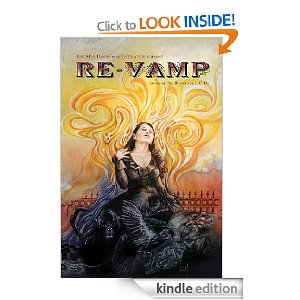
REVAMP! - Down with Vapid Vampires!

          Revamp is an on-line horror fest, the idea of two writers, Die Booth and L C Hu, aka the Mad Doctors of Literature.
          Tired of modern horror clichés, such as the swoony, teenage, angst-ridden vampire, Hu and Booth wanted to encourage a return to the older, folk-lore rooted horror story, and they posted their stories on-line and invited others to submit tales of vampires, were-wolves, ghosts and zombies.
          For a whole year, from Hallowe’en 2010 to Hallowe’en 2011, lovers of spooks and things that snarl in the night were able to dip into the site, sure of finding a good story.
          Now an anthology of the Revamp stories is available, both as a paper book and as an e-book.  I haven’t space to mention every story, but I was struck by the vivid exactness of detail that characterises all of them.  The writers understand that a monster of any kind is far more frightening if it’s present as part of a time and place we can picture ourselves in, and for that, precise observation is needed.
          This exactness, this clarity of imagination can be seen, for instance, in Die Booth’s Found – a lovely take on the classic Jacob’s story The Monkey’s Paw, and one which doesn’t suffer by comparison.  Anyone who has been in a Northern English city, with sooty, rainy streets, and poky little houses, can walk inside this story (and be chilled by it.)
          Tessa Brown, with exact detail, sets a scary ghost story on a train, and an equally scary zombie story in a biodome.  This last may not be a place most people are acquainted with, but the writer’s casual allusion to the office, the plants, show that she has imagined herself squarely inside it – and that clarity of the writer’s vision enables the reader to step inside it too.
          I very much enjoyed Booth’s Tangled Thread, for its contrasting voices.  It begins as a Victorian ghost story, and I read it while holding my breath and waiting for the false note.  It never came: Booth is pitch perfect.  If I had read this story without knowing anything about it, I would have taken it for a period story reprinted from an old magazine.  The second half of the story is told by an American street kid, in a voice that couldn’t be more different.
          Strong narrative voices appear elsewhere.  I enjoyed Michele Rimmer’s The Maggot, and loved her cool Brummie narrator (an undertaker), who addresses her one-night stand as ‘Bab’.  (I come from near Birmingham and have been called ‘bab’ a few times!)
          In L C Hu’s Natural Beast, we have an icily correct aristocratic narrator who plans to murder his brother in rather the same tone he might plan the redecoration of his rooms.  (And which is the greater beast, this story asks, the wolf or the man?)  Hu also has a chilling tale of a nascent serial killer, narrated by the killer’s mother.  The subtle glimpses of the family’s life, and the mother’s detached tone, tell us more than the words themselves.
          Many of the best stories take the horror themes and spin them, taking a sidelong, unexpected view – and the desire to reconnect with folklore is surely present in Booth’s Fourth Ape, which echoes with the tale of Bluebeard, but has its own originality.

Liebster Blog Award
            Other readers will choose other favourites from among the stories, but this is an excellent collection, with skill, wit, originality and quite a few shocks, scares and creeps!
          And you may have noticed that the blog has won an award!  Of which, more next week.

      And Blot, you ask, where is Blot?
Blot is missing.  He may be shut in a garage somewhere.  I am searching the virtual neighbourhood and banging cans of tuna with a spoon.  I hope he'll be back by next week.