Showing posts with label Book review. Show all posts

Saturday, 24 June 2017

How To Be Free - a review

  Life is absurd. 


  Be merry. Be free.


This sentiment appears on the cover of How To Be Free and runs throughout the book.
It's a most entertaining read. Half the time I agreed with  Hodgkinson's arguments so wholeheartedly, I wanted to cheer. The rest of the time I thought them so crack-brained, I wanted to throw the book across the room. I always enjoy books like this. They make you think.
Tom Hodgkinson, The Idler
Tom Hodgkinson is the editor of The Idler and the author of How To Be Idle. From page one to the end, he rages against the 'mind-forged manacles' that keep people in jobs they hate in order to pay, often, for things they don't need or even really want. They just think they ought to want them. (In his opinion.)
Modern society, he argues, is in all but name, a slave society, but the chains are all 'mind-forged.' It forces people into a rigid system. First it educates them to believe in passing exams and 'getting a good job.' But a 'career' Hodgkinson argues, sets meaningless goals of 'sales targets', 'bonuses' and 'promotion.' People are convinced that a bigger house in a 'better' neighbourhood, a more expensive car, 'designer' clothes and kitchen gadgets are signs of success and, therefore, happiness. But none of these things are, fundamentally, what make people happy.
And, of course, in our present society it's impossible for everyone to have a high-flying career. Some simply aren't interested and they're called stupid, feckless, unambitious and lazy. Others are broken by the stultifying demands of 'career' and many are suddenly made redundant by economic shifts they have no control over. These people are labelled 'failures,' which does its own psychological damage.
The whole notion of 'a good job' and 'a career' are, Hodgkinson says, traps and enslavements. The things that make human beings happy are: friends and family, having a laugh with them, creativity, control over your own life, growing things and tending animals, and having plenty of time to be idle and think.
The book is a series of 29 short essays, all ending with a rousing slogan. Among them are:-
  • Banish Anxiety: Be Carefree - Ride a bike.
  •  The Tyranny of Bills and the Freedom of Simplicity - Play the ukelele.
  • Reject Career and All its Empty Promises -  Find your gift.
  • Escape Debt - Cut Up Your Credit Card.
  • Forget Government -  Stop Voting.
  • Reject Waste, Embrace Thrift - Shovel Shit! 
  • Stop Working, Start Living -  Play.
It's all energetically, playfully and wittily written, but Hodgkinson really means it. Every chapter has its own note at the end, giving hints on how you might practically follow up the advice.

As a grumpy old Leftie, I muttered and mumbled about public-school educated Poshos telling the rest of us how to live - haven't we had a gut-full of that, for gods' sake? And it's all right for some with their Trust Funds and the Bank of Mummy and Daddy to fall back on...

But then I had to admit that, for most of my life, I've followed most of what Hodgkinson suggests. I am, I suppose, what he likes to call 'a Bohemian.' Indeed, a rather hard Glaswegian of my acquaintance nicknamed me and Davy 'The Brummie Bohemians' when we learned that, not only weren't we married, but we had no intention of ever getting married. (I was only surprised that this friend thought it worth commenting on at all.)

I didn't plan to be a Bohemian - but then, I've never gone in for life-plans or even five-year-plans. They strike me as very odd. I had no idea I was 'stepping outside the system' or being free. Mostly, I thought I was being broke, but apparently being broke is the new rich.

I've never had 'a career' or wanted one. (My writing is sometimes called 'a career' but, well, hardly.) I've lived from advance to lecture-fee to royalty. I am very frugal and thrifty (some would say stingy.) I will spend money, if I have to, on things I really want - books, travel, plants. Everything else is cheap or second-hand and never replaced until there's not another day's use in it. Because what I don't spend on non-essentials I can put towards stuff I'll enjoy. (And of course, what's 'essential' is open to definition. Fashionable clothes and house redecoration are, for me, non-essential in the extreme whereas books, single malt whisky and trips to the Hebrides... )

I've always had plenty of time to be idle, to read, to think, to write, draw, learn, make... It's also true that I've rarely felt such satisfaction as I have with my recent (and on-going) creation of a wildlife garden combined with growing my own fruit and vegetables. Hodgkinson is a hugely enthusiastic gardener and wants everyone to garden - and I have to agree with him about gardening as a source of happiness.

Hodgkinson blames the sorry state of slavery that exists today on 'Puritans.' He really hates 'Puritans.'

In the good old, Catholic Middle Ages, according to him, we all lived in a demi-paradise. We each of us had our cosy little cottage with a small-holding and all we had to do in return for it was a couple of days' light work a week on the lord's land - and, of course, as we all worked together, there was lots of good fellowship and cheer and it wasn't like work at all really.

The rest of the time we could work at our own pace on our own business, growing our own food or working, with creativity and satisfaction, at some useful craft like blacksmithing, pottery or basket-making. (All working-class crafts, which workers had no choice but to do, all recently taken up as 'artisan jobs' by the middle-classes like Hodgkinson. Excuse my grump. My great-grandfather was a blacksmith: my grandfather was a brick-maker. Neither did the work in order to be happy. Neither had much choice about it.)

Brueghal's peasants whooping it up on one of their many carefree holidays.
 
The Catholic Church was a benevolent overseer to this golden Merry England, providing lots of gorgeous ritual, music and holidays to lighten our days. Life was just wonderful all the time.

But then came the Reformation and the rise of Capitalism. The Catholic church and all the monasteries were destroyed. The peasants' common land was stolen from them and enclosed for the rearing of sheep. Families who'd been comfortably self-sufficient became hired farm hands in tied cottages. Land began to be something the rich speculated in to make fortunes, rather than something used by and for the whole community, to raise food.

Things just got worse and worse with the rise of industry and the dark, satanic mills. Workers became disposessed 'hands' and 'mechanics', forced to work miserably in terrible conditions, for inhumanly long hours, for a pittance. The medieval guilds where masters and men worked together vanished, and Unions were formed from the workers' desperation. Ever since then, workers and employers have been at loggerheads, one side for ever trying on some chicanery in order to make more profit and the other side forever on the defensive, trying to claw out some quality of life from the hellish urban landscape.

Wrong but Wromantic                          Right but Repulsive
For Hodgkinson, the Middle Ages and the 17th Century Cavaliers represent Ease, Joy, Grace, Elegance, Freedom.

Later centuries and the Puritans represent Greed, Narrowness, Ugliness, Rudeness, Joylessness and Slavery. It all reminds me of 1066 and All That, where the Cavaliers are summed up as 'Wrong but Wromantic,' and the Roundheads as 'Right but Repulsive.' (The beautiful drawing is by John Reynolds.)

I recognise that there are some grains of truth in Hodgkinson's account. The idea that all peasants, throughout the entire 400 years or so that make up 'the Middle Ages' were all plague-ridden, shit-encrusted and starving all the time is a nonsense. Excavations have revealed that many 'peasants' lived comfortable and prosperous lives. They did have more public holidays than we do and they could work as hard or as lightly as they chose, just as workers in the later cottage-industries could. As Marx put it, before the Industrial Revolution, work was a part of life. After, work was a sacrifice of life. (But did medieval peasants think that on a freezing cold morning when they had to go out and plough?)

The medieval Catholic Church often did serve a benevolent social role, providing work for makers of beautiful things, giving alms, keeping guest houses for travellers and taking the sick into its care.

But, but... I can't help feeling that Hodgkinson's view of the Middle Ages is seen not so much through rose-tinted specs as a shocking-pink blindfold. The Catholic Church was often anything but benevolent - the Inquisition? The witch-hunts? The Crusades? The slaughter of the Cathars? Where do these things fit into the happy, singy-dancy medieval dream?

And that cosy medieval world of Hodgkinson's, where everybody loves everybody else and they're always singing and dancing and feasting? Were there never any cold winters or hungry gaps? - How about this, from Piers Plowman, by Langland, who was actually present at the time, 600 years ago?


“As I went on my way,
I saw a poor man over the plough bending.

His hood was full of holes,
And his hair stuck out.
His shoes were patched,
His toes peeped out as he the ground trod.
His wife walked by him
In a skirt cut full and high,
Wrapped in a sheet to keep her from the weather,
Bare foot on the bare ice
So that the blood flowed.
At the field’s end lay a little bowl,
And in there lay a little child wrapped in rags
And two more of two years old upon another side.
And all of them sang a song
That was sorrowful to hear.
They all cried a cry,
A sorrowful note.
And the poor man sighed sore and said
“Children be still.”


And with all Hodgkinson's railing against 'slavery' I was a little taken aback at his description of the American Civil War as one fought between the 'rude North and the courteous South.' He doesn't mention that one of the South's 'courteousies' was the enslavement and mistreatment of other human beings. I'll take the grasping North's rudeness, thanks, over that kind of 'courtesy.' It was this kind of thing which enraged me and made me throw the book aside.

Even so, I picked it up again. I can't help agreeing with Hodgkinson more often than I disagree with him. I think he is often silly,  but still has the big picture of our society and how it needs to change, framed about right.

I recommend the book as a stimulating, entertaining and, perhaps, even world-changing read.


The Ghost Drum won the Carnegie Medal.
 
 Ghost Dance and Ghost Song are also available.


The Sterkarm Handshake won the Guardian Fiction Prize. 
 
 
available.


Saturday, 12 March 2016

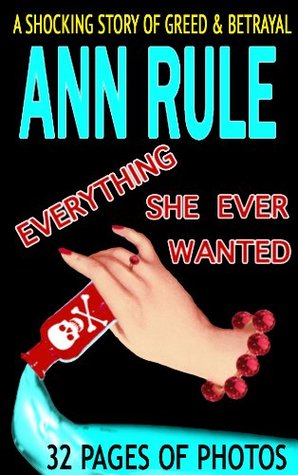
"Everything She Ever Wanted" by Ann Rule


Everything She Ever Wanted
It's hard to believe that this is an account of murders, attempted murders and trials that actually happened. It's way too over the top for fiction. No reader would ever believe it.

At the centre of it all is the woman born Mary Linda Patricia Vann, but usually known as Pat Allanson.

It is very hard to know what to make of her.

On one hand, she seems to have lived in a fantasy. She not only lived with her parents into old age, but lived on them, at their expense. In fact, her demands drove them into poverty. She seemed to have seen herself as an incarnation of Scarlett O'Hara, and wanted a Southern mansion where she could breed Morgan horses - despite the fact that the cost of such a place was far beyond her means.

She saw herself as a delicate, gentle Southern belle, bravely overcoming her ill-health and frailty. When challenged, she would cry or faint. One of her daughters observed that, despite this fraility, she could easily lift heavy saddles on and off horses' backs - and, in fact her worst illness, an abcess which nearly killed her from blood-poisoning, was self-inflicted. Medical check-ups revealed that, otherwise, she was strong as one of her horses.

Did her fantasy vision of herself, and her wild rages when she didn't get 'everything she ever wanted' mean that she was mentally ill? It certainly seems outside the range of 'sane'.

And yet, she seems to have planned her actions carefully, and covered them up, in a way that doesn't suggest the disordered thinking of madness. She was so cunning that most of the crimes which it seems certain she committed, could not be pinned on her.

So, what did she do? Well, she married Tom Allanson, a blacksmith who had wealthy parents, even though he was estranged from them. Pat Allanson seems to have nurtured the ill-feeling between them.

Her parents-in-law were murdered in their basment, and their son was arrested for the crime. He was certainly present at the time of the killings - he'd gone there at his wife's suggestion, to try and heal the breach between them. He went at a time when he knew his difficult father was at work, and he could talk alone with his mother.

Before going to his parents' house, he dropped his frail, delicate wife at her doctor's for an appointment. So, who was the woman who phoned his father's office and informed him that his son was at his home? Even more mysterious, who cut the telephone wires to the Allanson house?

After Allanson was jailed for murdering his parents, his loving wife arranged control of most of his finances. The failing ranch her husband had bought her burned down and she got the insurance. His grandmother had had a stroke and his grandfather was elderly, so loving Pat moved into nurse them, won their trust, and gained their signature to papers which let her control their finances.

https://en.wikipedia.org/wiki/File:Arsenic_trioxide024.jpg
She tried to convince her jailed husband that he should join her in a suicide-pact. She was older than him, and frail and he was going to be in jail for so long. She couldn't bear to be without him - and the only way they could be together was in death.

Allanson steadfastly refused. If he'd agreed, and killed himself in prison as Pat Allanson wanted, maybe she would have killed herself to join him - or maybe she would have stayed alive and inherited from him. What do you think?

Allanson's grandfather, under Pat's care, was rushed to hospital and nearly died from a mysterious illness which later turned out to be arsenic poisoning.

Detectives were certain that he'd been poisoned by his loving grandaughter-in-law, Pat Allanson, but they could not prove it. They could not discover where she'd obtained the arsenic or how she'd fed it to the old couple - though some time later a house-sitter became gravely ill after eating hot-dogs and ice-cream from the old people's freezer. Evidence of poisoning, however, had been flushed away and the detectives were frustrated again.

But I could not possibly untangle this woman's criminal career in a short review. Suffice to say, that people who encountered her continued to suffer the symptoms of arsenic poisoning, until the possibility that she was innocent becomes very hard to believe. Among those who suffered long-term painful illness identical to that caused by arsenic poisoning was Pat Allanson's own adult daughter.

Throughout, Pat Allanson's own doting mother maintained that her daughter was innocent and harmless.

The cover may be lurid but don't let it put you off. This is a truly eye-popping account of just how mad those mortals be.

Saturday, 13 February 2016

Review: The Stranger Beside Me by Ann Rule

I have a friend who I first bonded with over our shared interest in
The Stranger Beside Me by Ann Rule
psychopaths.

          My interest is, thank god, an academic one, a writer's curiosity about the extremes of human behaviour. My friend, poor woman, married a psychopath and has first hand experience of the dedicated selfishness that a human being can be capable of, the blind inability to appreciate that anyone except them has any right to an opinion, a life or free will.
          But when it comes to psycho-spotting, author and journalist Ann Rule can perhaps claim the prize.
          As a journalist, she often handled crime reports, spent a lot of time in police stations talking to detectives and made several friends on the force.
Ann Rule, from her Amazon page
          In her 40s, she volunteered to man phones on a suicide help-line, and shared her regular night-shift with a psychology student named Ted. She thought him a lovely young man and they became good friends, despite the age-gap of ten years. He was so caring towards the callers and at the end of her shift, he always walked her to her car, to make sure she was safe - whereas her detective friends, when she left their offices late at night, would say, "We'll watch from the window and if anyone mugs you, we'll phone 911."

     This little anecdote perhaps highlights something about psychopaths (and human nature.) Rule's detective friends were showing genuine concern and covering it with a joke. They probably knew there was little risk to her and, as ordinary human beings with many other concerns, they said goodbye and got on with their lives and jobs.
          'Ted', on the other hand, was acting a role, performing the character of 'lovely young man and caring friend.' It was convincing so long as it was never tested. One difference between someone telling the truth and a liar is that the truth-teller has 'an expectation of belief' because they know that they're telling the truth and therefore don't think they need bother to be meticulously convincing. They give a rough account, forget details - or assume that their genuine affection is apparent and needs no display.
          Liars know themselves to be lying and therefore go several extra miles in order to convince. Their stories are neatly in order, with lots of irrelevant detail to 'hide the lie among truths.' When it comes to relationships, their false affection is constantly voiced,  rehearsed and displayed. And takes many in.  Alas, research has shown that, though most of us think we can tell when someone is lying, we're actually very bad at it.

          Rule was no longer working with Ted, but was still in touch
Seattle, wikimedia
with him, when young women started disappearing from the Greater Seattle area. Rule was soon aware, from her friends in the Police, that they feared they were dealing with a serial killer. When suspicion fell on Ann Rule's friend, Ted, she thought it was obviously a routine enquiry or a mistake...

          But it wasn't. Ann's friend was Ted Bundy, and she found herself in the middle of the crime story that would define her career. For ever after she would be, the woman who worked beside Ted Bundy.

          Bundy abducted, terrified, raped and murdered many women, possibly more than a hundred. Like most serial killers, he probably started much earlier than the crimes he was charged with. Rule's research turned up the fact that, when Bundy was 15, a young girl, a child, was abducted from her home and murdered. The killer was never found. Bundy lived a few doors away, and knew the child. He never admitted to that killing - but he never admitted to anything unless there was an advantage for him.
          He was eventually arrested in Seattle, but insisted on representing himself, which gave him the right to make trips to the library to look at law books. While swearing complete innocence and mistaken arrest, he used a library trip to escape.

          He ran to Florida, but couldn't give up his hobby. Or was killing his addiction, his crutch? Within a week of arriving in Florida, he attacked several women in one night, killing three and leaving others badly injured.
Florida Capitol, wikimedia
          Bundy found Florida less careless and forgiving than the North-West. They sentenced him to death and placed him in a far  more secure prison. Another escape attempt was thwarted and after that he was kept in chains. Yes, he could have his trips to the law library - in chains.
          Now you would think that, to him, life was cheap. He had, after all, killed an unknown number of women for fun. Their lives and everything and everyone their lives had encompassed, had been as disposable, to him, as a condom. So what was a little matter of a death sentence, when life is so unimportant?
          But only other people's lives were unimportant to Bundy. He tried every possible delaying tactic, trick and appeal to preserve his own life. He also attempted to use the names of the women he'd murdered, and the sites where he'd dumped their bodies, as bargaining tools. Grant him another appeal, let him live a little longer, and he might give up a few more identities and a few more remains for burial.

          Bundy was an exemplary serial killer in that he demonstrates just how loathsome a nasty piece of work a human being can be - and yet he had a little fan club of female fools who were besotted with him. One even married him and had his child.
          If the psychology of serial killers is strange, the psychology of their groupies defeats me.

         If you share my interest in the minds of psychopaths, then Rule's book is of great interest. It sprawls a little, because she has updated it regularly over more than twenty years.
          Besides knowing the loathsome Bundy personally, and having access to him in jail, she has also interviewed many of the people he bereaved, which throws up some intriguing stories.
          The husband of one murdered woman was away on business on the day she was abducted. He told Rule that, in his distant hotel room, late on that day, he clearly heard his wife's voice say, "Help."
          Bundy's final killing spree took place in a university dormitory. He broke in, and lay in wait in darkened corridors. Rule interviewed a couple of survivors who survived because, as they told Rule, they became seized by what seemed, at the time, an inexplicable fear. One girl was in a bathroom and only had to step across the dark corridor to her bedroom, but found herself completely unable, for fear, to open the door. She had no idea why. She had no idea, consciously at least,  that Bundy was murdering her fellow students a little way down the corridor. This almost psychic awareness of danger reminds me of another book I've reviewed - Gavin de Becker's Gift of Fear.
         The Stranger Beside Me is often a grim read, but it's an informative one.

Saturday, 23 August 2014

Big Fat Lies - a review

Big Fat Lies by David Gillespie
          'Big Fat Lies - How the Diet Industry Makes You Sick, Fat and Poor' is by an Australian lawyer, David Gillespie. He was fat, and he wanted to be thinner, but found, like so many of us, that diets don't work. So he started researching the subject.  
          As he says, he may not be a doctor or nutritionist, but what lawyers are really good at is following the evidence - which he presents in Big Fat Lies.
           The tale that Gillespie uncovers about sugar and High-Fructose Corn Syrup is the same one told by Yudkin and Lustig in books previously reviewed here.  Sugar is an addictive poison, which is stuffed into almost every manufactured food item because Big Food knows that it's hard for us to resist its addictive sweetness. So they sell more, and we end up with 'an obesity epedemic.' 
          Also, sugar is a cheap preservative, and helps to make it possible for packaged food to sit in warehouses and on shelves for months, even years, without decaying. (And food should decay - if it doesn't, then the colonies of bacteria who live in our guts, and do the work of digesting for us, can't do anything beneficial with it.)
Be afraid, be very afraid
          But Gillespie doesn't simply repeat what Yudkin and Lustig have told us. He discovers additional nuggets.
          Chromium, for instance. We need tiny amounts of the stuff to be healthy, and it's virtually impossible to be deficient in it (though that doesn't stop the food & diet industry from selling it to us in 'supplements' which don't work, and may even do harm.)
          However, if your diet is high in sugar and/or high-fructose corn syrup - if, say, you drink a lot of soft drinks, or ready meals, or takeaways with sugary sauces - then the sugar very efficiently carries the chromium out of your body, resulting in the theoretically impossible chromium-deficiency.
          And what is the effect of chromium-deficiency? Oh, have a guess - go on, guess. Chromium-deficiency makes us resistant to insulin, that's what. Which means high blood-sugar and diabetes 2.
          It also means high insulin levels, as the body floods the blood-stream with insulin in an attempt to reduce blood-sugar. And how does insulin reduce - or attempt to reduce - blood-sugar levels?
          By turning the excess sugar into fat. and tidying it away into fat cells.
          So you're constantly hungry, constantly craving more sugar, and your weight gain is accelerated. A state of affairs that the processed food and diet industries are very happy about. A cynical person might suspect that, if they didn't exactly set out to create that state, they're very happy to perpetuate it.
        (Remember how the tobacco industry denied, for decades, that there was any link between smoking and cancer? And banged on about 'the freedom to smoke?' (And the freedom to acquire all the disease associated with it.) Then it turned out that Big Tobacco had known there was a link with cancer for decades, for almost all the time they'd been denying there was and insisting that 'the research was inconclusive.'
          (What does the food industry say, when it's told that sugar is poisonous and addictive? Sounding very like the tobacco industry, it says that sugar is simply a food like any other, that there is no clear link to disease or weight gain 'as part of a calorie controlled diet' and consumers should have the freedom to choose. So stop worrying, shut up, and have another fizzy drink.
          (When huge, multi-national industries start being ever so worried about your 'freedom', be afraid, be very afraid.)

          There's another condition which has been increasing, besides diabetes, and that's thyroidism. Pollution's been blamed; radioactive fall-out has been blamed. But you know what? There's another possible cause, much closer to home. A high sugar/fructose diet blocks the absorption of iodine, which means thyroid problems. Fancy that.

          Big Fat Lies book is not so much eye-opening as eye-popping - and one of its most eye-popping aspects is on just how little research and poor evidence the 'government' and 'medical' nutritional advice has been based for the past thirty years and more.
Good for us all along?
          For thirty years we've been told that saturated fat is bad for us, gives us strokes and heart attacks. We should avoid fat, and eat a lot of carbs to fill us up - potatoes and bread and rice and pasta. And if we have to have fat, it should be vegetable oil.
          It turns out that not only is this wrong - but it was always known to be wrong.

          Ancel Keys was the man who designed the American army's field rations for WWII - that's why they're called 'K-rations,' the 'K' being short for 'Keys.' This seems to have given him a lot of influence at government level.
          So when he published research demonstrating a link between high saturated fat consumption and heart-attacks, the American government listened. Keys' study, published in 1953, looked at the saturated fat consumption in 7 countries: Japan, UK, Italy, Wales, Australia, Canada and the US. His stats showed, with perfect correlation, that the higher the fat consumption in these countries, the higher the rate of deaths from heart disease. This research is what all the 'avoid the killer fry-up' advice has stemmed from.
          And it was nonsense. Even at the time, Keys' contemporaries pointed out that if he'd used the figures for Israel, Austria, Switzerland, Germany, Netherlands, Finland and Norway instead, his graph would have 'proved' exactly the opposite: that the more saturated fat consumed, the fewer deaths from heart disease.
          Combine the figures from these 14 countries, and there is no significant correlation at all. The figures prove nothing whatsoever - unless you cherry-pick those that show what you've already decided the result should be.
           Nor is there any proven link between cholesterol in the blood and heart-disease - but statins, which disrupt the body's natural functioning in order to lower its cholesterol production, are the highest selling drug in the world.
          I wonder if there's a connection between that and the continuing message that 'high cholesterol means a high risk of death from a heart-attack.' (It doesn't. There is no clear connection between cholesterol in the diet and heart-attacks, and no evidence at all that eating a diet low in saturated fat has any effect on cholesterol levels in the blood.)

          Dr William Castelli, part of the long-running Framingham Study, said in 1992 that, in fact, Framingham was finding that those who ate the most saturated fat, weighed least and were most active.

          Gillespie uncovers evidence - and names the papers - to show that, in fact, the most dangerous fats are those we're constantly being urged to eat: the polyunsaturated seed oils, such as sunflower, rape and canola oil. They have been strongly linked to cancer - and may even be the cause of the increasing number of skin-cancers. Not sunlight and sunburn after all - since we've evolved, over thousands of years, to cope with sunlight. Rather, the cause seems to be the action of sunlight on the polyunsaturated (and therefore, chemically, highly reactive) fat stored just under our skin.
          If you're interested in your own or your family's health - or are just increasingly suspicious of the multi-nationals which control our food and sway our governments, this is a book worth reading.
          It's also worth reading if you'd like to get back to this:


          Lard is good for you!
          Or, at least, not bad for you.           You might also find this link interesting.